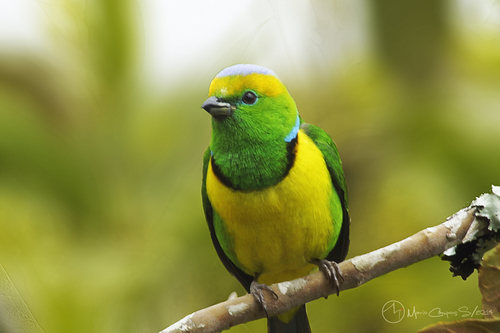
Golden-browed Chlorophonia
Chlorophonia callophrys
A dazzling gem of the Central American cloud forests, the Golden-browed Chlorophonia captivates with its neon green plumage and brilliant violet crown. This high-altitude specialist is a favorite for birders exploring the misty peaks of Costa Rica and Panama.
Quick Identification
Size
Length of 13 cm (5.1 in); weight approximately 24–25 g (0.85–0.88 oz)
Colors
Brilliant emerald green body with a bright golden-yellow forehead and eyebrow. Violet-blue crown and nape, and a blue rump. Males have a faint yellow breast-band that is less distinct or absent in females.
Key Features
- Bright golden-yellow forehead and 'eyebrow'
- Iridescent blue crown and violet-blue nape
- Short, thick-set finch-like silhouette
- Vibrant emerald green wings and back
When You’ll See Them
Geographic range
Where Does the Golden-browed Chlorophonia Live?
This vibrant finch is a jewel of Central America, found exclusively in the high-altitude regions of the Talamancan range. Its core territory spans the central and southern highlands of Costa Rica, extending south into the western mountains of Panama. This species is an endemic specialist, restricted to the narrow volcanic corridors where mist and moss dominate the landscape.
Basemap © OpenStreetMap contributors
Behavior
The Golden-browed Chlorophonia is a master of camouflage despite its neon colors, often blending perfectly into the moss-covered branches of the cloud forest canopy. They are social birds, frequently seen in pairs or small family groups, and occasionally joining mixed-species foraging flocks to move through the treetops in search of fruiting trees. Their movements are deliberate and somewhat slow compared to other finches, as they meticulously glean berries from epiphytes.
While they are generally shy and spend much of their time in the high canopy, they can become quite bold when specific food sources like mistletoe are fruiting. Their vocalizations are a series of soft, mournful whistles—a two-note 'tee-dee'—that can be difficult to pinpoint in the dense fog of their mountain habitat. Despite their stunning appearance, they remain relatively elusive to casual observers due to their preference for the high forest interior.
EverydayEarth exclusive
Camera Tips
To capture the Golden-browed Chlorophonia, height is everything. These are canopy-dwelling birds, so placing your camera on a second-story balcony or using a pulley system to hoist a weather-proof setup into the mid-story (15-25 feet) is your best bet. Look for 'hotspots' where epiphytes and mistletoe are growing on mossy limbs; these are their primary grocery stores. Angling the camera slightly downward from a higher branch toward a fruiting cluster will provide the most dramatic, eye-level footage.
While they don't visit traditional seed feeders, they are highly attracted to water features in highland gardens. A heated birdbath or a dripping fountain located near the forest edge can lure them down from the canopy. If you are using a trail camera, set it to a high-speed trigger or video mode, as their feeding motions are subtle and they may sit still for long periods while digesting berries, potentially failing to re-trigger a slow PIR sensor.
Lighting in the cloud forest is notoriously tricky due to frequent fog and low light. Use a camera with a high-quality sensor that handles low-light well without blowing out the highlights. The 'Golden-brow' is incredibly reflective; in direct sun, its blues and greens can flare, so a position with dappled sunlight is ideal for capturing the true depth of its iridescent plumage. Early morning is the peak activity time for feeding, so ensure your camera is active by dawn.
Similar Species
Species that look similar or are commonly confused with Golden-browed Chlorophonia.
Frequently Asked Questions
Record Golden-browed Chlorophonia at your habitat
Connect a camera to start building your own species record — AI identifies every visitor automatically.