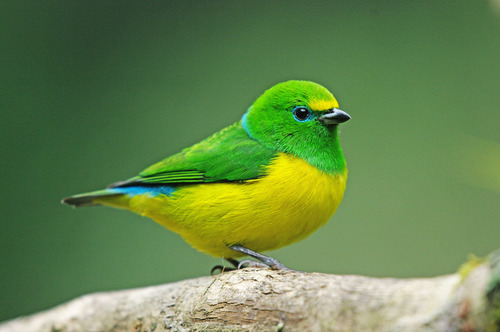
Blue-naped Chlorophonia
Chlorophonia cyanea
A jewel of the South American canopy, the Blue-naped Chlorophonia dazzles with its electric green plumage and signature turquoise neck. This vibrant finch is a favorite for birdwatchers and backyard explorers from the Andes to the Atlantic Forest.
Quick Identification
Size
Length: 4.3–4.7 inches (11–12 cm); Weight: 0.4–0.5 oz (11–15 g)
Colors
Vibrant grass-green body; males feature a brilliant sky-blue nape, eye-ring, and rump with a bright yellow belly; females are overall duller green with a yellowish-green belly.
Key Features
- Electric blue patch on the back of the neck (nape)
- Bright yellow lower underparts in males
- Short, thick bill and stocky build
- Distinct blue ring encircling the eye
When You’ll See Them
Geographic range
Where Does the Blue-naped Chlorophonia Live?
This stunning species is native to the South American continent, found across a wide but fragmented range that spans several major ecosystems. It is a resident of the Andes, stretching from Venezuela and Colombia down through Ecuador, Peru, and Bolivia, while a separate population thrives in the Atlantic Forest regions of Brazil, Paraguay, and northeastern Argentina. It is notably absent from the Amazon basin's lowlands and the arid regions of Chile and Uruguay.
Basemap © OpenStreetMap contributors
Behavior
The Blue-naped Chlorophonia is an energetic and highly social finch, most often observed moving in pairs or small family groups. They are characteristic 'canopy dwellers,' spending much of their time in the upper layers of the forest, though they frequently descend to forest edges and clearings in search of ripe fruit. Their movement is characterized by quick, acrobatic hops, and they are known to hang upside down to reach berries on thin outer branches.
While they are not as vocal as some other tropical birds, their calls are distinctive—a series of soft, metallic whistles and 'teee' notes that often reveal their presence before they are seen. They are generally peaceful and are often seen participating in mixed-species foraging flocks, moving alongside tanagers and honeycreepers through the fruiting trees of the South American highlands.
EverydayEarth exclusive
Camera Tips
To successfully capture the Blue-naped Chlorophonia on your backyard or trail camera, the most important factor is 'fruit placement.' These birds are specialists and are rarely attracted to traditional grain-based bird feeders. Instead, position your camera near native fruiting trees or shrubs, particularly those with small, soft berries. If you are using a feeder platform, offering halved oranges, bananas, or papaya can lure them down from the canopy into the camera's field of view.
Water is the second most effective draw. Blue-naped Chlorophonias are frequent bathers and prefer shallow, elevated water sources. Placing an AI camera near a birdbath equipped with a small fountain or dripper is ideal, as the sound of moving water acts as a beacon for them. Mount your camera at a height of 5–7 feet, aiming slightly downward at the water or fruit source, and ensure you have a clear line of sight through the foliage to avoid false triggers from wind-blown leaves.
Because these birds are small and move with sudden, jerky motions, camera settings are crucial. Use a fast trigger speed—ideally under 0.3 seconds—and set the camera to 'Burst Mode' to take 3–5 photos per trigger. This increases your chances of getting a sharp shot of that signature blue nape rather than a green blur. If your camera supports it, recording in 4K video at 60fps is the best way to capture the iridescent quality of their feathers, which can look different depending on how the light hits them.
Lighting can be tricky with such vibrant birds. Try to position your camera so it faces North or South to avoid the harsh backlighting of sunrise and sunset. The best 'hero shots' occur in the soft, diffused light of early morning (7:00 AM to 9:00 AM) when the birds are most active and the colors of their plumage appear most saturated and true-to-life.
Similar Species
Species that look similar or are commonly confused with Blue-naped Chlorophonia.
Golden-sided Euphonia
Euphonias generally have darker, often blue-black upperparts, whereas Chlorophonias are dominated by bright grass-green plumage.
Golden-browed Chlorophonia
Found in Central America, it features a prominent yellow forehead and lacks the extensive blue nape of its South American cousin.
Frequently Asked Questions
Record Blue-naped Chlorophonia at your habitat
Connect a camera to start building your own species record — AI identifies every visitor automatically.