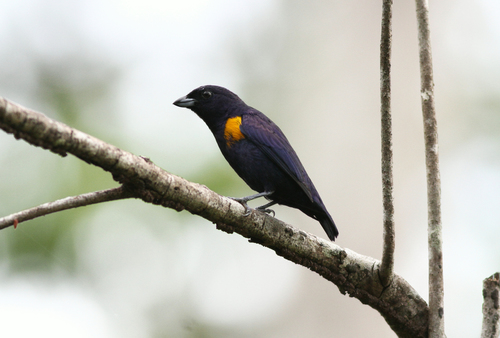
Golden-sided Euphonia
Euphonia cayennensis
A hidden gem of the northern Amazon, the Golden-sided Euphonia swaps the typical yellow belly of its cousins for a sophisticated blue-black suit accented with brilliant golden 'epaulettes.' This canopy-dwelling specialist is a master of mimicry and a devoted lover of tropical fruits.
Quick Identification
Size
Small songbird, typically 11 cm (4.3 in) in length; weighs between 12-16 grams (0.42-0.56 oz)
Colors
Males are glossy blue-black overall with bright golden-yellow patches on the sides of the breast. Females are olive-green above and yellowish-green below with a distinct gray patch on the throat and breast.
Key Features
- Uniformly blue-black upperparts and underparts in males
- Bright yellow tufts on the sides of the breast (males)
- Grayish-white throat and breast in females
- Short, thick-based bill
- Small, compact silhouette
When You’ll See Them
Geographic range
Where Does the Golden-sided Euphonia Live?
The Golden-sided Euphonia is native to the lush tropical regions of northern South America. Its core range is centered within the Guiana Shield, encompassing almost the entirety of Guyana, Suriname, and French Guiana. Beyond these borders, it thrives in the eastern reaches of Venezuela and extends southward into the northern Brazilian Amazon, particularly north of the Amazon River. It is a lowland specialist, rarely venturing into high-altitude montane regions.
Basemap © OpenStreetMap contributors
Behavior
The Golden-sided Euphonia is a highly active and social bird that spends much of its time in the forest canopy. Unlike many other euphonias that have bright yellow bellies, this species is uniquely dark underneath, making it look almost like a small blackbird until the sun hits its golden 'armpits.' They are often observed in pairs or small family groups, moving quickly through the foliage in search of ripening fruit.
These birds are known for their habit of joining mixed-species foraging flocks, often following larger birds through the treetops. They have a varied repertoire of whistles and are excellent mimics, frequently incorporating the calls of other local birds into their own songs. Despite their forest-dwelling nature, they are generally not shy around human dwellings if there are appropriate fruiting trees nearby, though they prefer to remain high above the ground.
EverydayEarth exclusive
Camera Tips
To capture the Golden-sided Euphonia on camera, elevation is key. These birds rarely descend to ground level, so your AI camera should be mounted as high as possible—ideally on a second-story balcony, a high fence post, or even strapped to a tree trunk overlooking a clearing. If you can position your camera so it looks across at a fruiting canopy rather than up at the sky, you will avoid the 'silhouette effect' where the bird appears as a dark shadow against a bright background.
Food is the best lure for this species. If you live within their range, planting native mistletoe or fruiting shrubs like melastomes will naturally draw them in. For a more immediate result, a platform feeder offering halved bananas, sliced papaya, or oranges can be effective, especially during the drier months when natural fruit may be less abundant. Place the feeder in a spot that receives dappled sunlight so the camera can pick up the metallic sheen of the male's blue-black feathers.
Because these birds are small and move with quick, jerky motions, set your camera to a high trigger speed or use a 'Burst' mode to capture multiple frames. If your camera supports 4K video, use it; the golden patches on the male's sides are often only visible when he fluffs his feathers or takes flight, and high-definition video is much better at catching these fleeting flashes of color. Early morning is the best time for activity, as they are most vocal and active just after sunrise.
Similar Species
Species that look similar or are commonly confused with Golden-sided Euphonia.
Frequently Asked Questions
Record Golden-sided Euphonia at your habitat
Connect a camera to start building your own species record — AI identifies every visitor automatically.