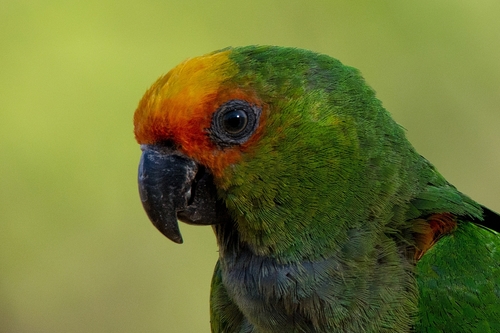
Golden-capped Parakeet
Aratinga auricapillus
Endemic to the lush forests of Brazil, the Golden-capped Parakeet is a vibrant symbol of the Atlantic Forest. With its brilliant yellow crown and social personality, this stunning conure is a favorite for backyard birders and conservationists alike.
Quick Identification
Size
Length 30 cm (12 in); weight 140-150g (4.9-5.3 oz)
Colors
Mainly green body with a bright golden-yellow forehead and crown; red feathers around the eyes and a red patch on the lower belly; blue-tinged flight feathers
Key Features
- Distinctive golden-yellow 'cap' on the forehead
- Large red patch on the abdomen
- Dull red skin around the eyes (periophthalmic ring)
- Long, pointed tail with a green and blue hue
When You’ll See Them
Geographic range
Where Does the Golden-capped Parakeet Live?
Native to the South American continent, the Golden-capped Parakeet is a proud endemic of Brazil. Its range is concentrated in the eastern and southeastern regions of the country, spanning from Bahia and Minas Gerais down to Paraná. While it remains a resident in these areas, its presence is increasingly restricted to forest fragments and protected reserves due to ongoing habitat loss.
Basemap © OpenStreetMap contributors
Behavior
The Golden-capped Parakeet is a gregarious and highly social bird, often found in noisy flocks ranging from a few pairs to groups of 20 or more. They are known for their constant vocalizations, which consist of loud, metallic screeches used to maintain contact with the flock while flying or foraging. Despite their social nature, they are quite sensitive to changes in their environment, making them an excellent indicator of forest health.
During the day, they are most active during the cooler morning and late afternoon hours, spending the midday heat resting in the shaded canopy. While they are primarily canopy-dwellers, they have been known to adapt to agricultural landscapes and plantations if sufficient tree cover is available. Their interactions with humans are typically cautious; they are prone to fly off if approached, but in settled areas, they may become accustomed to regular food sources in gardens.
EverydayEarth exclusive
Camera Tips
To capture the stunning plumage of the Golden-capped Parakeet, elevation is your best friend. Because they are primarily arboreal, mounting your camera 2 to 3 metres (7 to 10 feet) high on a tree trunk or a specialized bird-feeding station is much more effective than ground placement. Angle the camera slightly downward to catch the birds as they land on perches. If you have a fruiting tree like a guava or a native fig in your yard, focus your lens on the outer branches where the fruit is most accessible.
Lighting is the biggest challenge in tropical environments. Aim to place your camera where it receives filtered morning light; this will illuminate the 'golden cap' without washing out the deep greens of the body. Avoid pointing the camera directly into the sun, as these parakeets will easily turn into dark silhouettes. Using a high-definition video setting is recommended over still photos, as their social interactions—such as mutual preening or playful squabbling—are best captured in motion.
During the drier months, an elevated water source is an irresistible lure. A solar-powered bird bath or a dripper mounted near a branch can attract an entire flock. In terms of camera settings, ensure your trigger speed is set to its fastest possible interval; these birds are rapid fliers and rarely stay in one spot for long. If you're using bait, sunflowers seeds or local fruits are effective, but be prepared for other parrot species to join the party.
Similar Species
Species that look similar or are commonly confused with Golden-capped Parakeet.
Frequently Asked Questions
Record Golden-capped Parakeet at your habitat
Connect a camera to start building your own species record — AI identifies every visitor automatically.