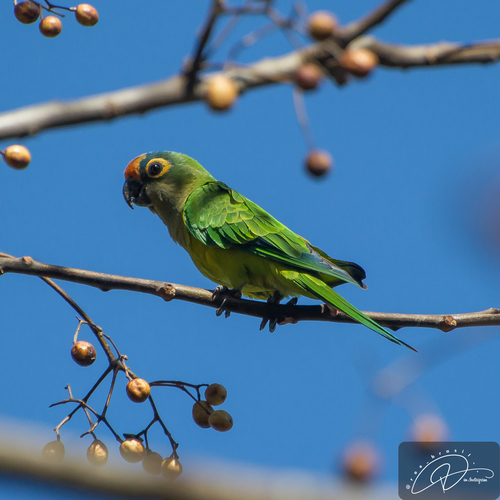
Peach-fronted Parakeet
Eupsittula aurea
Meet the Peach-fronted Parakeet, a social and spirited emerald of the South American savanna. Known for its glowing orange brow and raucous chattering, this adaptable bird brings a splash of tropical color to every backyard it visits.
Quick Identification
Size
Length: 26–30 cm (10–12 in); Wingspan: 40–45 cm (16–18 in); Weight: 80–105 g (2.8–3.7 oz)
Colors
Primarily vibrant green; forehead is a distinctive peach-orange; crown features a blue wash; yellow-orange skin around the eyes; pale horn-colored beak.
Key Features
- Bright peach-orange forehead patch
- Large yellow-orange naked eye-ring
- Green body with blue-tinted crown
- Long, tapering pointed tail
- Pale grayish-horn colored beak
When You’ll See Them
Geographic range
Where Does the Peach-fronted Parakeet Live?
The Peach-fronted Parakeet is a quintessential resident of South America's interior landscapes. It occupies a massive range that stretches across the heart of Brazil, encompassing the vast Cerrado and Caatinga biomes, and extends westward into eastern Bolivia and southward through Paraguay into northern Argentina. Smaller, isolated populations can also be found in parts of Suriname and southeastern Peru, making it one of the most widely distributed parakeets on the continent.
Basemap © OpenStreetMap contributors
Behavior
Peach-fronted Parakeets are highly social and gregarious birds, almost always found in pairs or small flocks ranging from 10 to 30 individuals. They are well-known for their noisy and energetic nature, often heard before they are seen. Their calls are a series of high-pitched screeches and chattering that they use to maintain contact with the flock while flying or foraging through the canopy.
In the wild, these parakeets exhibit a mix of arboreal and terrestrial behavior. While they spend most of their time in the treetops feeding on fruits and seeds, they aren't afraid to descend to the ground to drink water or forage for fallen seeds and minerals. They are non-territorial except during the nesting season, when they typically use old woodpecker holes or hollowed-out termite mounds to raise their young.
Because they are highly adaptable, they have become a common sight in suburban areas and urban parks within their range. They show a surprising level of tolerance for human activity, often visiting backyard bird feeders and fruit trees. Their intelligence and playful social interactions make them a favorite for backyard observers, as they can be seen allosticking (grooming each other) and playing among the branches.
EverydayEarth exclusive
Camera Tips
To capture the best footage of Peach-fronted Parakeets, placement is everything. These birds are drawn to water, especially in drier regions or during the dry season. Setting up your camera near a bird bath or a shallow water feature with a solar-powered dripper is the most reliable way to get clear, close-up shots. Position the camera at a slight downward angle about 3 to 5 feet away from the water source to capture the vivid orange of their foreheads as they dip their heads to drink.
If you are using a feeder, opt for platform feeders rather than tube feeders. They prefer a stable surface where they can land and interact with their mates. Fill the feeder with sunflower seeds, cracked corn, or fresh fruit slices like papaya and mango. Because they are social, you are likely to capture multiple birds at once, so ensure your camera's field of view is wide enough to catch the flock's interactions.
Lighting is crucial for showing off their iridescent green and blue feathers. Try to place your camera in a spot that receives bright, indirect morning sun. Direct, harsh midday sun can wash out the delicate peach tones on their face. Set your camera to a high-speed trigger or video mode with at least 30fps, as these parakeets are fast-moving and constantly twitching their heads and tails.
Finally, consider the height of your setup. While they do come to the ground for water, they feel safest slightly elevated. Mounting your camera on a fence post or a tree limb at roughly 5 or 6 feet (around 1.5 to 2 meters) looking toward a popular perching branch will result in more natural 'wild' behavior captures than a ground-level setup.
Similar Species
Species that look similar or are commonly confused with Peach-fronted Parakeet.
Frequently Asked Questions
Record Peach-fronted Parakeet at your habitat
Connect a camera to start building your own species record — AI identifies every visitor automatically.