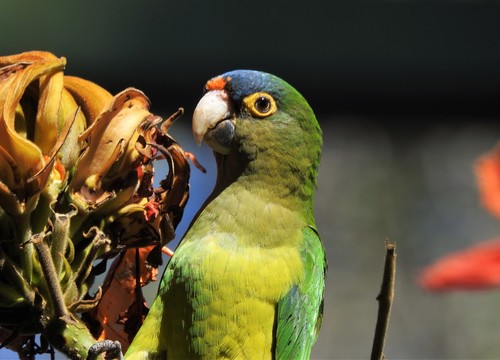
Orange-fronted Parakeet
Eupsittula canicularis
A social and vibrant inhabitant of Central America's Pacific slope, the Orange-fronted Parakeet is easily recognized by its citrus-colored crown and noisy, energetic flocks. Whether nesting in termite mounds or visiting suburban gardens, these adaptable parrots are a highlight for any backyard wildlife observer.
Quick Identification
Size
Length: 22–24 cm (8.7–9.4 inches); Wingspan: Approx. 35 cm (14 inches); Weight: 65–80 grams (2.3–2.8 oz)
Colors
Primary green body with a vibrant orange-red band across the forehead. Dull blue flight feathers visible during flight, olive-green throat and chest, and a prominent creamy-yellow eye-ring.
Key Features
- Bright orange band on the forehead
- Pale yellow, featherless ring around the eyes
- Dull blue primary wing feathers
- Nests frequently in arboreal termite mounds
When You’ll See Them
Geographic range
Where Does the Orange-fronted Parakeet Live?
The Orange-fronted Parakeet is native to the Pacific slope of North and Central America, thriving in the warm, seasonal tropical zones. Its range begins in western Mexico, specifically in the state of Sinaloa, and stretches south through the lowlands of Guatemala, El Salvador, and Nicaragua, reaching its southern limit in northwestern Costa Rica. While primarily a resident of these Pacific lowlands, small introduced populations occasionally appear in urban centers outside their natural range due to their popularity in the cage-bird trade.
Basemap © OpenStreetMap contributors
Behavior
The Orange-fronted Parakeet is a highly social and vocal bird, typically seen in pairs or small, energetic flocks of 10 to 30 individuals. They are famous for their unique nesting strategy; they use their powerful, hooked beaks to excavate tunnels inside active arboreal termite mounds. This provides the eggs and chicks with a stable, warm environment and protection from many predators. They are extremely noisy in flight, emitting a series of high-pitched screeches that can be heard long before they are seen.
In the wild, these parakeets spend much of their day foraging in the canopy, using their beaks as a 'third limb' to climb through complex branches. While they are wary of people in remote areas, they have become quite bold in suburban settings, often visiting backyard gardens and parks. During the hottest part of the afternoon, they tend to fall silent and rest in the deep shade of leafy trees, making them much harder to detect until they resume activity in the late afternoon.
EverydayEarth exclusive
Camera Tips
To capture the Orange-fronted Parakeet on camera, you must think vertically. These are canopy-dwelling birds that rarely descend to the ground, so a camera mounted at eye-level will likely capture only their shadows. Mount your camera 10 to 15 feet high on a tree trunk, angled slightly downward toward a known feeding branch or a bird bath. They are particularly attracted to water in the dry season, so a high-mounted basin can be a 'hotspot' for activity.
If you have fruiting trees like figs, guavas, or even certain types of palms in your yard, focus your camera there. Use a high-speed trigger or burst mode; these birds move quickly and are constantly fluttering their wings while feeding, which can cause motion blur on slower settings. A fast shutter speed is essential for getting that crisp shot of the orange forehead and blue wing tips. Because they travel in noisy flocks, one bird usually acts as a scout; if you see one on your live feed, keep watching, as several dozen may follow within minutes.
Placement near an arboreal termite mound during the nesting season (typically late winter to spring) can provide spectacular footage of their excavation process. Ensure your camera is set to a wide-angle view to capture the social dynamics of the flock, as they often interact, preen, and bicker while they wait for their turn at a food source. For the best lighting in the tropics, point your camera north to avoid direct sun flare during their peak morning and afternoon activity hours.
Similar Species
Species that look similar or are commonly confused with Orange-fronted Parakeet.
Frequently Asked Questions
Record Orange-fronted Parakeet at your habitat
Connect a camera to start building your own species record — AI identifies every visitor automatically.