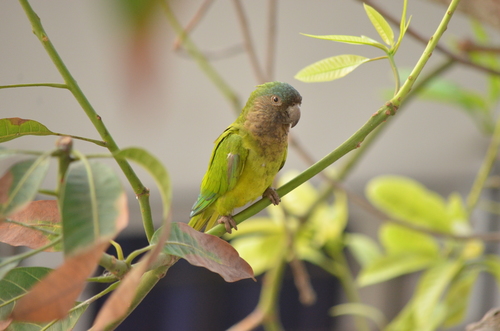
Brown-throated Parakeet
Eupsittula pertinax
A social and spirited resident of the tropical Americas, the Brown-throated Parakeet brings a splash of green and a lot of personality to any backyard. Known for their unique habit of nesting in termite mounds, these intelligent birds are a favorite for birdwatchers and camera enthusiasts alike.
Quick Identification
Size
Length of 17–25 cm (7–10 in); weight ranges from 70–100 g (2.5–3.5 oz)
Colors
Mainly green body with a characteristic brown or olive-brown throat and breast; many subspecies feature bright orange or yellow patches around the eyes and forehead; blue primary feathers visible in flight.
Key Features
- Brownish-olive wash over the throat and upper chest
- Bright orange or yellow eye-patch (subspecies dependent)
- Slender green body with a long, pointed tail
- Loud, screeching 'can-can-can' calls while in flight
When You’ll See Them
Geographic range
Where Does the Brown-throated Parakeet Live?
Native to the Neotropical realm, the Brown-throated Parakeet is widely distributed across northern South America and southern Central America. Its core range includes Colombia, Venezuela, the Guianas, and northern Brazil, extending northward into Panama and Costa Rica. It is also a signature species on several Caribbean islands, including Aruba, Bonaire, and Curaçao, where distinct colorful subspecies have evolved.
Basemap © OpenStreetMap contributors
Behavior
Brown-throated Parakeets are exceptionally social birds, almost always seen in pairs or small, boisterous flocks. They are highly vocal and are often heard long before they are seen, communicating with sharp, metallic screeches as they fly between feeding sites. In suburban environments, they have adapted well to human presence and can become quite bold, frequently visiting garden bird tables and fruiting trees.
These parakeets exhibit fascinating nesting behaviors, often excavating holes inside active arboreal termite mounds. This provides a stable, temperature-controlled environment for their eggs. During the day, they spend much of their time foraging in the canopy, but they descend to lower levels for water or to investigate bird feeders. They are active and acrobatic feeders, often hanging upside down to reach ripe fruit or seeds.
EverydayEarth exclusive
Camera Tips
To capture high-quality footage of Brown-throated Parakeets, camera placement is everything. Since these birds are primarily arboreal, mounting your camera 5 to 10 feet off the ground, angled slightly downward toward a platform feeder or a sturdy branch, is most effective. They are highly attracted to bright, fleshy fruits; placing halved papayas, mangoes, or oranges in view of the lens will almost certainly draw them in if they are in the neighborhood.
Because they are social and often visit in groups, use a wide-angle setting on your camera to capture the interactions between individuals. They are most active in the early morning shortly after sunrise and again in the late afternoon before they head to communal roosts. Setting your camera's motion sensitivity to high is recommended, as their movements while feeding are quick and jerky.
Water is another fantastic lure. A raised birdbath or a dripping water feature can attract them for spectacular bathing shots. If you are using an AI-powered camera, ensure the area is well-lit, as their green plumage can blend into leafy backgrounds. Using a camera with a fast shutter speed or high frame rate will help freeze the action of their rapid wing beats and social squabbles.
Similar Species
Species that look similar or are commonly confused with Brown-throated Parakeet.
Frequently Asked Questions
Record Brown-throated Parakeet at your habitat
Connect a camera to start building your own species record — AI identifies every visitor automatically.