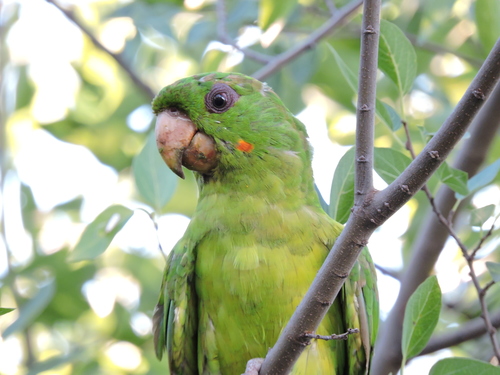
Green Parakeet
Psittacara holochlorus
The Green Parakeet is a social, emerald-hued marvel that brings a touch of the tropics to the backyard. Known for their loud calls and acrobatic flights, these parrots are a favorite for birdwatchers across the Rio Grande Valley and Mexico.
Quick Identification
Size
Length of 32 cm (12.6 in); wingspan of approximately 48–54 cm (19–21 in); weight between 180–235 g (6.3–8.3 oz)
Colors
Uniformly bright emerald green with slightly more yellowish-green underparts; pale, horn-colored beak; creamy-white bare eye-ring
Key Features
- Entirely green plumage without large patches of other colors
- Large, heavy, pale-colored hooked bill
- Long, pointed graduated tail
- Pale, featherless ring around the eye
When You’ll See Them
Geographic range
Where Does the Green Parakeet Live?
The Green Parakeet is native to the North American continent, primarily occupying the eastern slopes of Mexico from Nuevo León and Tamaulipas down to Veracruz. In the United States, they are a celebrated fixture of the Rio Grande Valley in southern Texas, where they are considered a native resident species rather than an escaped exotic population. Their range is largely dictated by the availability of nesting cavities and year-round food sources, leading them to thrive in both tropical deciduous forests and lushly landscaped suburban neighborhoods.
Basemap © OpenStreetMap contributors
Behavior
Green Parakeets are highly social and energetic birds that are almost always found in noisy flocks, ranging from a few individuals to several hundred. They are exceptionally vocal, especially during flight, emitting harsh, screeching calls that often announce their arrival long before they are seen. In suburban environments, they have adapted remarkably well, frequently using power lines as staging areas and tall palm trees or chimneys as communal roosting sites.
Their daily routine is highly predictable; they depart communal roosts at sunrise to forage for food and return in a spectacular display of aerial acrobatics just before dusk. While they can be wary of humans in the wild, suburban populations are often quite bold, visiting backyard bird feeders and birdbaths with regularity. Their interactions are characterized by constant chatter and social grooming within the flock, though they can be territorial around nesting hollows.
EverydayEarth exclusive
Camera Tips
To capture the best footage of Green Parakeets, camera placement is everything. These birds are arboreal and rarely descend to the ground, so avoid low-mounted cameras. Instead, secure your AI-powered camera to a high fence post, a second-story balcony, or a tree limb overlooking a platform feeder. Angling the camera slightly downward from a high vantage point will capture their vibrant green backs and the details of their social interactions on feeders.
Baiting is highly effective for this species. They are particularly attracted to large platform feeders stocked with black oil sunflower seeds or fresh tropical fruits like mango, papaya, and halved oranges. If you have a birdbath, place a camera nearby; Green Parakeets are enthusiastic bathers, and the splashing action makes for excellent video triggers. Ensure the camera has a fast trigger speed, as their movements are quick and jerky.
Timing is crucial for capturing flock activity. Program your camera or check your notifications most closely during the 'golden hours'—the first two hours after sunrise and the two hours before sunset—when the birds are most active and the light beautifully saturates their emerald feathers. During the heat of midday, they often retreat to the shade of dense foliage, making them harder to spot. If your camera allows for it, use a high frame rate (60fps) to capture the rapid flapping of their wings in crisp detail.
Similar Species
Species that look similar or are commonly confused with Green Parakeet.
Frequently Asked Questions
Record Green Parakeet at your habitat
Connect a camera to start building your own species record — AI identifies every visitor automatically.