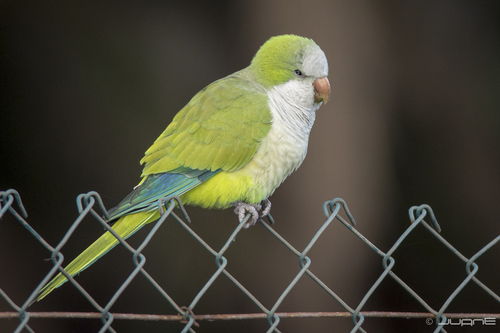
Monk Parakeet
Myiopsitta monachus
The only parrot that builds its own 'apartment complex' out of sticks, the Monk Parakeet is a social, bright-green marvel that has successfully traded South American savannas for suburban backyards.
Quick Identification
Size
28-30 cm (11-12 in) long; wingspan of 48-53 cm (19-21 in); weight of 100-150 g (3.5-5.3 oz)
Colors
Bright lime-green body; greyish face and breast with darker scalloping; blue primary wing feathers; pale tan beak; sexes are identical.
Key Features
- Grey face and breast resembling a monk's cowl
- Bright green plumage with blue flight feathers visible during flight
- Large, communal stick nests often built on utility poles
- Loud, raspy screeching calls
When You’ll See Them
Geographic range
Where Does the Monk Parakeet Live?
Originally native to the temperate and subtropical heart of South America, the Monk Parakeet calls the grasslands and woodlands of Argentina, Brazil, Uruguay, and Bolivia its home. However, this resilient species has become a global citizen, establishing thriving feral populations across North America and Europe. You can now find these bright green residents in urban centers ranging from the sunny palm trees of Florida to the snowy rooftops of Chicago and the parks of Madrid and London.
Basemap © OpenStreetMap contributors
Behavior
Monk Parakeets are exceptionally social and intelligent birds, famous for being the only parrot species that constructs its own nest rather than using tree cavities. They are colonial nesters, working together to build massive, multi-chambered "apartment complexes" out of sticks and twigs. These nests can house dozens of pairs, each with its own private entrance, and provide excellent insulation against both heat and cold.
In a backyard setting, these parrots are highly vocal and active. They often forage in large flocks, maintaining constant communication through a series of loud squawks and chatters. While they can be wary of new objects, they are quick learners and will frequently visit established feeding stations, often dominating smaller birds due to their size and communal strength. Their interactions are complex, involving mutual preening and cooperative nest maintenance.
EverydayEarth exclusive
Camera Tips
To capture the best footage of Monk Parakeets, position your AI-powered camera near a platform feeder or a large hopper feeder. These birds prefer stable surfaces where they can land as a group. Filling your feeder with black oil sunflower seeds or safflower seeds is the most effective way to draw them in. Because they are social, you are likely to get multiple birds in a single frame, so use a wide-angle lens setting if your camera allows it to capture their group dynamics.
Height is a critical factor for parakeet placement. They feel safest when feeding at least 5 to 7 feet off the ground, with a clear line of sight to nearby trees where they can retreat if spooked. If you have a large stick nest in a nearby tree or utility pole, try to angle a camera toward the entrance holes. You’ll capture fascinating "construction" footage as they constantly fly back and forth with new twigs to reinforce their massive homes.
Lighting is key for highlighting their vibrant colors. Position the camera so the sun is behind it during the morning hours, which will make their lime-green feathers and blue wing tips pop against the background. Since Monk Parakeets are quite loud, ensure your camera's microphone is active; the AI can often use their distinct screeching calls as a secondary trigger to begin recording before the bird even enters the visual frame.
During the winter months in northern climates, Monk Parakeets are highly dependent on human-provided food. This is the best time to capture high-activity footage. Offer high-energy suet cakes alongside seeds to keep them coming back. Set your camera’s trigger sensitivity to high, as their movements are quick and jerky, especially when they are competing for space at the feeder with other colony members.
Similar Species
Species that look similar or are commonly confused with Monk Parakeet.
Frequently Asked Questions
Record Monk Parakeet at your habitat
Connect a camera to start building your own species record — AI identifies every visitor automatically.