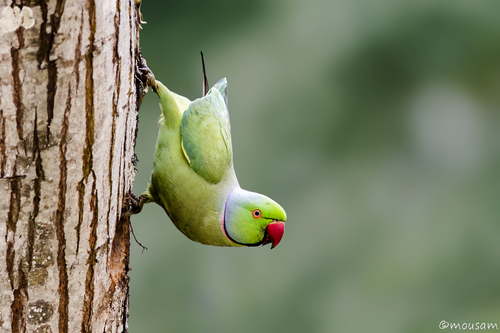
Rose-ringed Parakeet
Psittacula krameri
With its brilliant lime-green feathers and unmistakable tropical charm, the Rose-ringed Parakeet is a stunning addition to any backyard bird list. Whether in their native Indian forests or a city park, these intelligent parrots bring a splash of color and a lot of personality to the camera lens.
Quick Identification
Size
Length: 38–42 cm (15–16.5 in); Wingspan: 42–48 cm (16.5–19 in); Weight: 100–140 g (3.5–5 oz)
Colors
Primary plumage is vibrant lime-green. Adult males feature a distinct black neck ring with a rose-pink border at the back. Deep red, hooked bill.
Key Features
- Long, slender graduated tail making up half the total body length
- Vibrant lime-green plumage with a bright red hooked beak
- Adult males display a black and rose-pink collar around the neck
- Loud, shrill 'kee-ak' screeching calls
When You’ll See Them
Geographic range
Where Does the Rose-ringed Parakeet Live?
The Rose-ringed Parakeet is native to two distinct tropical belts: one stretching across northern sub-Saharan Africa and the other covering the Indian subcontinent. It has become one of the world's most successful invasive avian species, with thriving feral populations established throughout Europe, the Middle East, and parts of the United States. In these introduced ranges, they are most common in metropolitan areas where mild winters and abundant garden food sources support year-round residency.
Basemap © OpenStreetMap contributors
Behavior
The Rose-ringed Parakeet is a highly social and intelligent bird, often seen in noisy, fast-flying flocks. They are gregarious by nature, particularly at communal roost sites where hundreds or even thousands of birds gather at dusk. While they can be wary in wilder settings, populations in urban and suburban areas have become remarkably bold, often frequenting garden bird feeders and showing little fear of humans.
These parakeets are incredibly adaptable cavity nesters, often utilizing holes in older trees or even cracks in buildings. Their foraging strategy is energetic; they spend much of their day moving between food sources, communicating with loud, piercing squawks that make them impossible to miss. In many introduced regions, they have formed stable feral colonies that thrive alongside native species, sometimes competing for nesting sites.
EverydayEarth exclusive
Camera Tips
To capture these vibrant birds on camera, focus on high-traffic areas like bird tables or hanging feeders. Unlike ground-feeding birds, Rose-ringed Parakeets prefer to feed at an elevated position where they feel secure. Mount your AI-powered camera 5 to 7 feet off the ground, angled slightly downward toward a sturdy feeder. They are particularly fond of large sunflower seeds and suet, but offering fresh fruit like apple slices or halved grapes can act as an irresistible lure that keeps them in the frame longer.
Timing is crucial for the best lighting and activity levels. These parakeets are most active shortly after sunrise and again in the late afternoon before they head to communal roosts. Set your camera to burst mode or high-speed video, as their movements can be erratic and fast. Because they often travel in pairs or small groups, use a wider field of view if your camera allows; this ensures you capture the social interactions rather than just a single bird's head.
During the spring nesting season, look for them investigating tree cavities. If you have a mature tree with a hollow, placing a camera nearby can provide a glimpse into their nesting behavior. Be aware of their bright green plumage—in lush summer foliage, they can be surprisingly well-camouflaged. Use high-contrast settings or ensure your camera is positioned to capture them against a neutral background like a wooden fence or a brick wall to make their colors pop.
Similar Species
Species that look similar or are commonly confused with Rose-ringed Parakeet.
Frequently Asked Questions
Record Rose-ringed Parakeet at your habitat
Connect a camera to start building your own species record — AI identifies every visitor automatically.