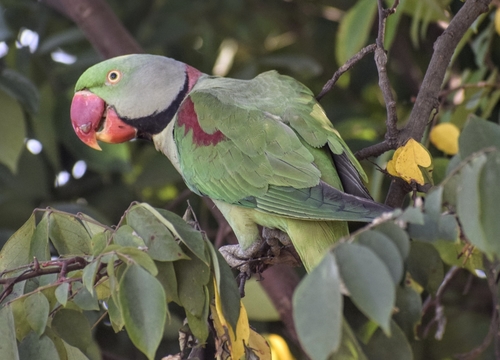
Alexandrine Parakeet
Psittacula eupatria
The Alexandrine Parakeet is a regal, emerald-hued icon of the Asian canopy. Named after Alexander the Great, these intelligent parrots are easily identified by their massive red bills and distinctive maroon shoulder patches.
Quick Identification
Size
Length: 56-62 cm (22-24 in); Wingspan: 19-21 cm (7.5-8.3 in) per wing; Weight: 200-300 g (7-10.5 oz)
Colors
Mainly green with a blue-grey sheen on the cheeks and nape. Distinctive maroon-red shoulder patches and a massive red bill. Males feature a black neck ring and a rose-pink band on the nape.
Key Features
- Massive deep-red bill with a yellow tip
- Distinctive maroon-red patch on each shoulder
- Extraordinarily long, tapered tail with blue-green central feathers
- Adult males have a prominent black and rose-colored neck ring
When You’ll See Them
Geographic range
Where Does the Alexandrine Parakeet Live?
Native to the sprawling landscapes of South and Southeast Asia, the Alexandrine Parakeet thrives from the foothills of the Himalayas through the Indian subcontinent and deep into the Indochinese peninsula. While their heartland includes countries like India, Thailand, and Myanmar, they have successfully established thriving feral colonies in urban centers across Europe and the Middle East. Whether in a dense deciduous forest or a bustling city park, these adaptable birds are masters of finding high vantage points in mature timber.
Basemap © OpenStreetMap contributors
Behavior
The Alexandrine Parakeet is a highly social and intelligent bird, known for its powerful flight and loud, ringing calls. In the wild, they typically gather in small flocks, though communal roosts in large trees can attract hundreds of individuals at sunset. They are incredibly vocal, communicating with a variety of coarse shrieks and squawks that can be heard over long distances. Their strong mandibles are not just for feeding; they are skilled climbers, using their beaks as a third foot to navigate through dense forest canopies.
These parrots are relatively bold but maintain a level of wariness around humans. In urban areas, they have adapted well to suburban life, often visiting garden bird baths and fruit trees. They are known for their longevity and complex social bonds, with pairs often remaining together for life. Their playfulness is a hallmark of their personality, frequently observed engaging in aerial acrobatics or manipulating objects with their feet to explore their surroundings.
EverydayEarth exclusive
Camera Tips
To successfully capture the Alexandrine Parakeet on your backyard or trail camera, height and vantage points are your most important considerations. These parrots are canopy-dwellers and rarely spend time on the ground. For the best results, mount your camera at least 10 to 15 feet high, ideally on a branch or pole that faces a known 'sentinel' limb—a bare branch where the birds often land to scan the area before descending to feed or drink. If you are using a bird feeder, a platform style is better than a tube feeder to accommodate their large size and long tails.
Baiting can be very effective for this species. They are particularly fond of fresh fruit; try securing half a pomegranate, a mango, or a cob of corn to a branch within the camera's field of view. Sunflower seeds and walnuts are also high-value treats that will keep them in front of the lens longer as they work to crack the shells. Because these birds are highly intelligent, they may be suspicious of new equipment. Camouflage your camera with leaf-patterned tape or tuck it into natural foliage to ensure they feel comfortable approaching.
In terms of camera settings, use the fastest trigger speed available. Alexandrine Parakeets move with surprising speed, especially when taking off. Setting your camera to 'Burst Mode' (3-5 photos per trigger) will increase your chances of catching a spectacular shot of their wings spread, revealing the hidden blue and yellow tones. Since they are most active during the 'golden hours' of dawn and dusk, ensure your camera’s low-light sensitivity is optimized to avoid grainy images. If your camera supports it, the 4K video setting is excellent for capturing their complex social vocalizations and playful interactions.
Similar Species
Species that look similar or are commonly confused with Alexandrine Parakeet.
Frequently Asked Questions
Record Alexandrine Parakeet at your habitat
Connect a camera to start building your own species record — AI identifies every visitor automatically.