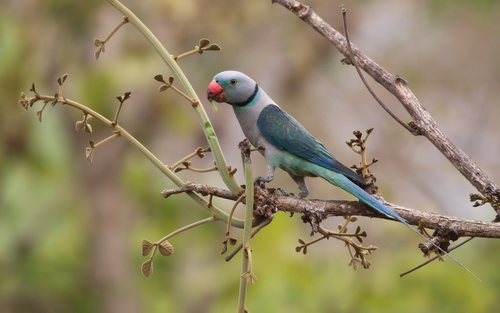
Malabar Parakeet
Psittacula columboides
A hidden gem of the Western Ghats, the Malabar Parakeet dazzles with its smoky grey plumage and vibrant blue wings. This elusive forest dweller is a must-see for bird lovers in southern India.
Quick Identification
Size
36–38 cm (14–15 inches) in length including the long tail; weight approx 85–100g (3–3.5 oz)
Colors
Soft bluish-grey head and breast, green back, and striking blue wings. Males have a red upper beak and a black neck ring; females have an all-black beak.
Key Features
- Long blue tail with a bright yellow tip
- Bluish-grey head and breast
- Black and turquoise neck collar on males
- Endemic to the Western Ghats of India
When You’ll See Them
Geographic range
Where Does the Malabar Parakeet Live?
This stunning parakeet is a true jewel of the Indian subcontinent, found exclusively within the lush, mist-shrouded peaks of the Western Ghats mountain range in southern India. Its core range stretches from the hills of Kerala and Tamil Nadu northward through Karnataka and into parts of Maharashtra and Goa. Because it is endemic to this specific biodiversity hotspot, it is a localized specialist that thrives in high-rainfall tropical environments.
Basemap © OpenStreetMap contributors
Behavior
The Malabar Parakeet is a highly social and energetic bird, typically seen in small, fast-moving flocks of 6 to 15 individuals. Unlike many other parakeets that frequent urban centers, this species is a specialist of the forest, navigating the dense canopies of the Western Ghats with incredible agility. They are famous for their rapid flight through forest clearings, often accompanied by a unique, grating call that is much harsher than the shrill whistles of the more common Rose-ringed Parakeet.
While they spend the majority of their time in the upper canopy, they are curious foragers and will descend to lower levels in search of fruiting trees or flowering shrubs. They are resident birds, meaning they don't migrate long distances, but they will wander locally following the seasonal ripening of wild fruits. Their social structure is tight-knit, and they are often heard communicating with one another through constant chatter while feeding or roosting.
EverydayEarth exclusive
Camera Tips
Capturing the Malabar Parakeet on an AI-powered camera requires a bit of vertical thinking. Because these birds are canopy-dwellers, a standard ground-level setup will rarely catch them. For the best results, mount your camera on a high balcony, a rooftop, or a tall tree trunk that has a clear view of a fruiting tree like a Wild Fig (Ficus) or a Silk-cotton tree. Angle the camera slightly downward to capture the birds as they land on the outer, sunlit branches.
If you live near a forest edge, you can attract them closer by providing a high-platform bird bath or a nectar feeder. They are particularly attracted to the color red and nectar-rich blossoms. Use a fast shutter speed or a high-frame-rate video setting on your camera; these parakeets are incredibly fast flyers, and their take-offs are often sudden. A burst mode of 3-5 photos per trigger is ideal for catching that perfect shot of their yellow-tipped tail feathers fanned out.
Lighting is the most critical factor for showcasing this bird's beauty. Their soft grey plumage and blue wings can look muddy in the shadows of a dense forest. Position your camera so it captures the warm, side-lit glow of the early morning or late afternoon. This will make the iridescent blue of their flight feathers pop against their smoky grey bodies. Avoid pointing the camera into direct midday sun, which can cause harsh highlights on their light-colored heads.
Similar Species
Species that look similar or are commonly confused with Malabar Parakeet.
Frequently Asked Questions
Record Malabar Parakeet at your habitat
Connect a camera to start building your own species record — AI identifies every visitor automatically.