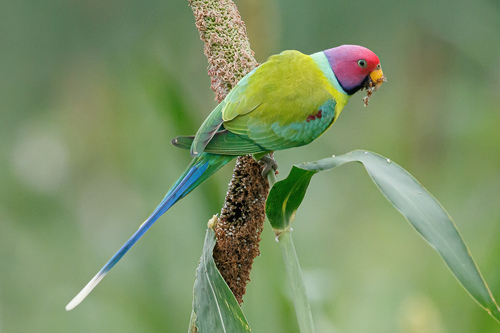
Plum-headed Parakeet
Psittacula cyanocephala
Meet the 'Jewel of the Indian Woods.' With its stunning iridescent head and elegant, sweeping tail, the Plum-headed Parakeet brings a splash of tropical brilliance to any backyard camera setup.
Quick Identification
Size
33-37 cm (13-14.5 inches) in length; Weight: 65-80 g (2.3-2.8 oz)
Colors
Bright green body; males have a plum-red head fading to purplish-blue with a black neck ring; females have a bluish-grey head with a yellow collar.
Key Features
- Plum-colored head with black neck ring (males) or grey head (females)
- Exceptionally long, slender blue tail with white tips
- Bright yellow upper mandible and dark lower mandible
- Swift, erratic flight pattern with musical 'tuink' calls
When You’ll See Them
Geographic range
Where Does the Plum-headed Parakeet Live?
The Plum-headed Parakeet is a stunning avian resident of the Indian subcontinent. Its native range extends across the majority of India, Pakistan, Nepal, Bhutan, and Sri Lanka, where it finds sanctuary in both tropical and subtropical wooded environments. While primarily a bird of the lowlands and foothills, it is a versatile species that has adapted well to human-altered landscapes near forest fringes.
Basemap © OpenStreetMap contributors
Behavior
Plum-headed Parakeets are highly social and energetic birds that typically move in small family groups or larger flocks when food is abundant. Unlike many of their louder parrot cousins, they are known for a relatively mellow temperament and a distinctive, musical call that sounds like a short, metallic whistle. They are incredibly agile in the air, capable of navigating dense forest canopies with rapid twists and turns.
In the wild, they spend much of their day foraging in the treetops or occasionally descending to agricultural fields. While they can be shy around humans initially, they are frequent visitors to suburban gardens and orchards where food is plentiful. During the breeding season, pairs become more territorial, searching for tree cavities to raise their young, often using holes previously excavated by woodpeckers or barbets.
EverydayEarth exclusive
Camera Tips
To capture high-quality images of the Plum-headed Parakeet, focus your efforts on water sources. These birds are frequent bathers, especially during the warmer months. Position your camera at eye level with a birdbath or shallow water feature, ensuring the lens is approximately 4 to 6 feet away. Use a fast shutter speed setting if your camera allows, as their movements during bathing and takeoff are incredibly rapid.
Feeding stations can also be very effective, but placement is key. Instead of a standard hanging feeder, try a flat platform feeder or mount a tray onto a sturdy branch. Bait the area with sunflower seeds, sliced pomegranate, or chopped guava. Because these parakeets are wary of ground-level predators, placing your camera and feeder at least 5 to 7 feet off the ground will make them feel much more secure and likely to linger in front of the lens.
Lighting is critical for capturing the iridescent quality of the male's plum-colored head. Aim to have your camera facing away from the sun (sun at your back) during the peak activity hours of early morning or late afternoon. If using an AI-powered camera with burst mode, set it to take 3-5 photos per trigger; this increases your chances of catching the perfect 'tail-spread' or the subtle blue-to-red gradient on the male's crown.
Similar Species
Species that look similar or are commonly confused with Plum-headed Parakeet.
Blossom-headed Parakeet
Very similar but features a paler pinkish-rose head and yellow tips on the tail feathers rather than white.
Rose-ringed Parakeet
Larger with a solid green head and a prominent red ring around the neck; lacks the plum/grey head coloration.
Malabar Parakeet
Endemic to the Western Ghats; has a bluish-grey mantle and a red beak in both sexes, with different head markings.
Frequently Asked Questions
Record Plum-headed Parakeet at your habitat
Connect a camera to start building your own species record — AI identifies every visitor automatically.