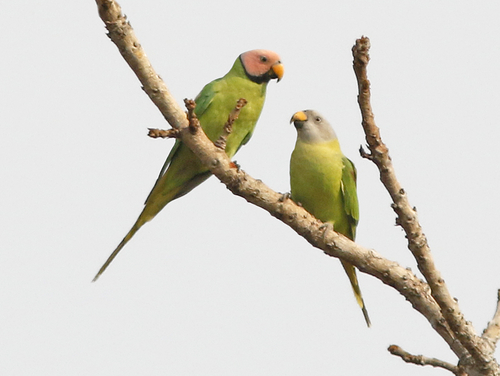
Blossom-headed Parakeet
Psittacula roseata
Adorned with a delicate rose-colored crown and a vibrant lime-green coat, the Blossom-headed Parakeet is one of Southeast Asia's most charming forest dwellers. These social parrots bring a splash of color and a lively soundtrack to any backyard they visit.
Quick Identification
Size
30 to 36 cm (11.8 to 14.2 inches) in length; wingspan of 40 to 45 cm (15.7 to 17.7 inches); weight 80-100g
Colors
Lime-green body; males have a rosy-pink head and maroon wing patches; females have a pale bluish-grey head and no wing patches.
Key Features
- Rose-pink or bluish-grey head distinct from green body
- Long slender tail with blue central feathers and white tips
- Male has a small maroon patch on each shoulder
- Yellow upper beak and dark lower beak
When You’ll See Them
Geographic range
Where Does the Blossom-headed Parakeet Live?
The Blossom-headed Parakeet is native to the lush landscapes of Southeast Asia and the eastern Indian subcontinent. Its core range extends from Northeast India and Bangladesh across Myanmar into Thailand, Cambodia, Laos, and Vietnam. These birds thrive in tropical and subtropical moist lowland forests, but they are also found in more open woodlands and agricultural peripheries where mature trees provide nesting and roosting opportunities.
Basemap © OpenStreetMap contributors
Behavior
Blossom-headed Parakeets are highly social and energetic birds often seen in small family groups or larger flocks of up to 30 individuals outside of the breeding season. They are remarkably fast flyers with a direct, darting flight path, often making sharp, musical whistling calls while in transit. Unlike some of their more urban-adapted relatives, they tend to be slightly more cautious and shy around human settlements, though they will readily colonize suburban areas that offer significant tree cover.
These parakeets spend much of their day foraging in the forest canopy, though they are known to descend to lower branches for water or specific fruiting plants. Their social structure is complex; they often roost communally and can be seen engaging in mutual preening, which helps strengthen pair and group bonds. While they are generally peaceful, they can become quite vocal and territorial near their nesting cavities during the breeding months.
EverydayEarth exclusive
Camera Tips
To capture the stunning colors of the Blossom-headed Parakeet, place your camera at an elevated vantage point. These birds rarely spend time on the ground, so mounting your camera 10 to 15 feet high on a tree trunk, angled toward a known perching branch or a high-hanging fruit feeder, is essential. If you are using a birdbath, ensure it is placed in an open area but near protective foliage, as they prefer to have a quick escape route into the trees.
Baiting is most successful with native fruits like guava, papaya, or sunflower seeds. Because they are attracted to blossoms, placing a camera near a flowering 'Bottlebrush' or similar nectar-rich tree can produce spectacular results during the blooming season. Set your camera to a fast trigger speed or a high-frame-rate video mode; these birds are quick to arrive and depart, and their social interactions are often too fast for standard photo intervals to catch.
The best time for recording is during the 'golden hours'—shortly after sunrise and just before sunset. Their pink and green plumage pop beautifully in warm, low-angled light. If your camera has adjustable settings, prioritize a high shutter speed to capture the detail in their tail feathers during flight. During the monsoon season, they may visit garden feeders more frequently as wild food sources become harder to access, so keep your batteries charged during rainy months.
Similar Species
Species that look similar or are commonly confused with Blossom-headed Parakeet.
Frequently Asked Questions
Record Blossom-headed Parakeet at your habitat
Connect a camera to start building your own species record — AI identifies every visitor automatically.