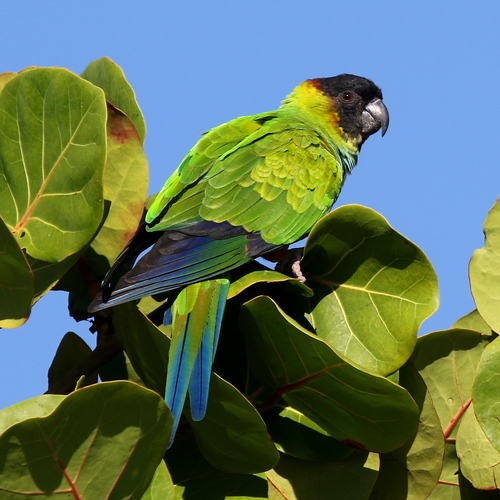
Nanday Parakeet
Aratinga nenday
With its striking black mask and vibrant green plumage, the Nanday Parakeet is a charismatic visitor to backyard feeders. These intelligent, social parrots bring a splash of tropical color and a lot of personality to suburban neighborhoods.
Quick Identification
Size
Length of 30-37 cm (12-15 in); Wingspan approximately 50-55 cm (20-22 in); Weight around 140-150 g (5 oz)
Colors
Bright lime-green body with a distinctive jet-black head (hood) and beak; blue-tinted flight feathers and tail; unique red feathers on the upper legs (thighs).
Key Features
- Distinctive jet-black hood and beak
- Bright red 'stockings' on the upper legs
- Long, pointed green tail with blue undersides
- Vibrant blue-black flight feathers visible in flight
When You’ll See Them
Geographic range
Where Does the Nanday Parakeet Live?
The Nanday Parakeet is native to the interior of South America, specifically the Pantanal region and the Chaco, spanning across Paraguay, northern Argentina, eastern Bolivia, and southern Brazil. However, due to its popularity in the pet trade, escaped birds have established thriving, self-sustaining populations in the United States, particularly in the coastal regions of Florida, southern California, and parts of Texas. These naturalized flocks are now a permanent fixture of the North American suburban landscape.
Basemap © OpenStreetMap contributors
Behavior
The Nanday Parakeet is an exceptionally social and gregarious bird, almost always seen in noisy, energetic flocks ranging from a dozen to several dozen individuals. They are famous for their loud, rasping vocalizations which they use to communicate while flying and foraging. In their social hierarchy, they are highly intelligent and often engage in communal grooming and playful displays within the flock.
In suburban environments, they have become remarkably bold and comfortable around humans. They are resourceful foragers, moving between various fruiting trees and backyard bird feeders throughout the day. While they can be wary of sudden movements, their curiosity often leads them to explore new objects or food sources in gardens, making them a delight—and sometimes a noisy neighbor—for backyard birdwatchers.
EverydayEarth exclusive
Camera Tips
To capture high-quality footage of Nanday Parakeets, platform feeders are significantly more effective than tube or hopper feeders. Because of their size and hooked beaks, they prefer a stable flat surface where they can stand comfortably while cracking open seeds. Mount your AI camera approximately 2 to 3 feet away from the platform, angled slightly downward to capture the bird's distinctive black facial markings and red leg feathers.
Baiting with black-oil sunflower seeds or safflower seeds is the most reliable way to attract a flock. For a special treat that encourages longer stays in front of the lens, try offering sliced apples, grapes, or orange halves secured to a branch or feeder tray. These birds are highly communal, so expect multiple visitors at once; a wide-angle lens setting is ideal to capture the social dynamics of the entire flock.
Timing is crucial for these parakeets. They are most active during the early morning hours and again in the late afternoon before they head to communal roosts. Ensure your camera is positioned to avoid direct lens flare during these golden hours. Because they are vocal, keeping the microphone enabled on your camera will help you identify their approach long before they land on the feeder, as their loud squawks are unmistakable.
Similar Species
Species that look similar or are commonly confused with Nanday Parakeet.
Frequently Asked Questions
Record Nanday Parakeet at your habitat
Connect a camera to start building your own species record — AI identifies every visitor automatically.