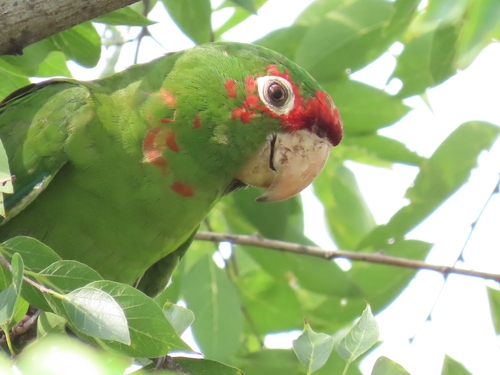
Mitred Parakeet
Psittacara mitratus
A vibrant burst of Andean green and red, the Mitred Parakeet is the charismatic parrot that has turned North American suburbs into tropical havens. Known for their intelligence and raucous social lives, these adaptable birds bring a high-energy soundtrack to every backyard they visit.
Quick Identification
Size
Length 34-38 cm (13.5-15 in); Wingspan approx. 50-55 cm (20-22 in); Weight 200-250 g (7-9 oz)
Colors
Primary plumage is a vibrant grass-green; forehead and area around eyes are bright red; scattered red feathers often appear on the neck and thighs. Beak is a pale, horn color.
Key Features
- Bright red forehead and 'mitre' patch
- Prominent creamy-white bare eye-ring
- Heavy, pale ivory-colored bill
- Long, pointed tail with olive-green undersides
When You’ll See Them
Geographic range
Where Does the Mitred Parakeet Live?
Native to the South American continent, the Mitred Parakeet primarily inhabits the eastern slopes of the Andes, stretching from central Peru through Bolivia into northwestern Argentina. While its heartland remains the temperate montane forests of the south, it has become a famous 'citizen of the world' through accidental and intentional releases. Large, self-sustaining feral populations are now thriving across the United States, particularly in the coastal urban corridors of California, the tropical suburbs of Florida, and throughout the Hawaiian Islands.
Basemap © OpenStreetMap contributors
Behavior
Mitred Parakeets are highly social and energetic birds that are almost never seen alone. In their native Andean habitats and introduced urban environments alike, they travel in noisy, tight-knit flocks that can range from a dozen to several hundred individuals. They are exceptionally vocal, communicating with a series of harsh, screeching calls that can be heard from blocks away, especially during their morning and evening commutes between roosting sites and feeding grounds.
These parrots are remarkably intelligent and adaptable. In suburban settings, they have learned to exploit human-provided food sources and can become quite bold around bird feeders. They exhibit complex social hierarchies and form strong, lifelong pair bonds. During the day, they spend a significant amount of time preening one another (allopreening) to reinforce social bonds, a behavior that makes for excellent backyard camera footage.
EverydayEarth exclusive
Camera Tips
To capture the best footage of Mitred Parakeets, position your camera at an elevated vantage point. These birds prefer to stay high off the ground, so mounting your device on a 6-to-10-foot pole or a high fence post near a known food source is ideal. Angle the camera slightly downward toward a sturdy landing branch or the top of a platform feeder to catch them as they land and interact.
Using a high-quality bird feeder filled with black oil sunflower seeds or large striped sunflower seeds is the most reliable lure. However, water is equally effective. A heated bird bath or a solar-powered fountain can be a magnet for these parrots, especially in drier climates like Southern California. Because they travel in large groups, ensure your camera has a wide-angle lens or is set back far enough to capture the group dynamic rather than just a single bird.
Set your camera to a fast shutter speed or high frame rate (60fps if available) to mitigate the motion blur from their rapid wing beats. Mitred Parakeets are extremely fast and jerky in their movements. Using 'burst mode' or short video clips is recommended, as their most interesting social behaviors—like bill-sparring or mutual preening—happen in quick, intense bursts.
Timing is critical for these birds. They are most active in the first two hours after sunrise and the two hours before sunset. During mid-day, they often retreat into the shade of dense trees to rest and digest. If you are using an AI-powered camera, ensure the sensitivity is high, as their bright green plumage can sometimes blend into leafy backgrounds, though their red faces usually provide enough contrast for modern detection algorithms.
Similar Species
Species that look similar or are commonly confused with Mitred Parakeet.
Red-masked Parakeet
The Red-masked has a much larger, solid red mask covering the entire face, whereas the Mitred has red mostly on the forehead and scattered spots.
White-eyed Parakeet
Lacks the red forehead of the Mitred, featuring only small red and yellow flecks on the neck and the leading edge of the wings.
Frequently Asked Questions
Record Mitred Parakeet at your habitat
Connect a camera to start building your own species record — AI identifies every visitor automatically.