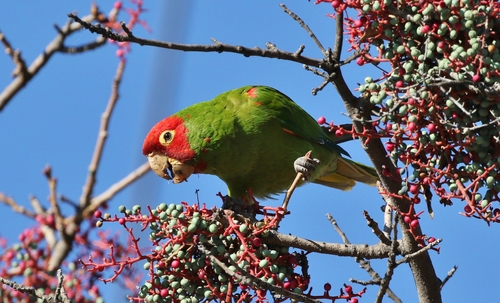
Red-masked Parakeet
Psittacara erythrogenys
Often called the 'Cherry-headed Conure,' the Red-masked Parakeet is a splash of tropical brilliance. Whether in their native South American forests or their famous urban colonies in California, these vocal, intelligent parrots are a favorite for backyard observers.
Quick Identification
Size
Length 33 cm (13 in), wingspan 45-50 cm (18-20 in), weight 165-200g (5.8-7 oz)
Colors
Vibrant lime-green body with a deep crimson-red mask covering the face and crown. Notable red patches on the 'shoulders' (bend of the wing) and red 'socks' on the thighs. Beak is a pale horn color.
Key Features
- Extensive red mask covering the forehead, crown, and cheeks
- Red patches on the bend of the wing and underwing coverts
- Prominent white ring of bare skin around the eye
- Long, pointed green tail and pale beak
When You’ll See Them
Geographic range
Where Does the Red-masked Parakeet Live?
Native to South America, the Red-masked Parakeet is naturally found along the Pacific slope of the Andes from southwestern Ecuador into northwestern Peru. Beyond its native range, it has gained worldwide fame for its successful introduced populations in the United States, particularly in San Francisco, Los Angeles, and Miami. These adaptable birds have also established small, localized colonies in several European cities, thriving in Mediterranean climates that offer abundant ornamental fruit trees.
Basemap © OpenStreetMap contributors
Behavior
Red-masked Parakeets are exceptionally social and gregarious birds that are almost never seen alone. They typically travel in noisy, high-spirited flocks that can range from a few pairs to several hundred individuals. In flight, they are fast and direct, often announcing their arrival with a series of loud, metallic screeches. Within the flock, pairs are often seen flying close together, reflecting their monogamous bonds.
They spend a large portion of their day foraging in the canopy or visiting suburban garden feeders. During the hottest part of the afternoon, they tend to retreat to the shade of dense trees to rest and preen each other. These parrots are known for their high intelligence and vocal mimicry; in urban areas, they have become quite comfortable around humans, though they remain cautious of direct approach. Their evening commutes to communal roosts are spectacular displays of synchronized flight and loud vocalizations.
EverydayEarth exclusive
Camera Tips
To capture the Red-masked Parakeet on your backyard camera, focus on food and water. These parrots are highly attracted to platform feeders stocked with black oil sunflower seeds or large nut mixes. Position your camera about 5-7 feet off the ground, aimed directly at the feeder. Because they travel in flocks, a wide-angle lens is better than a narrow one, as it will allow you to see multiple birds interacting at once rather than just a single close-up.
Lighting is the biggest challenge when photographing green birds. To get that 'pop' of red on their heads, place your camera in a location that gets morning light but is protected from the harsh, washing effect of the midday sun. If you have a birdbath, especially a solar-powered fountain, placing a camera nearby is a great strategy; these birds love to bathe in groups, and the action shots of them splashing can be much more dynamic than simple feeding photos.
For camera settings, use a fast trigger speed and high-frame-rate video if possible. Red-masked Parakeets are jittery and move their heads constantly. A 10-second video clip will often be more rewarding than a still photo, as you'll hear their distinctive social chatter. If your camera allows for 'burst mode,' set it to take 3-5 photos per trigger to ensure at least one shot captures the bird without motion blur as it cracks a seed.
Similar Species
Species that look similar or are commonly confused with Red-masked Parakeet.
Frequently Asked Questions
Record Red-masked Parakeet at your habitat
Connect a camera to start building your own species record — AI identifies every visitor automatically.