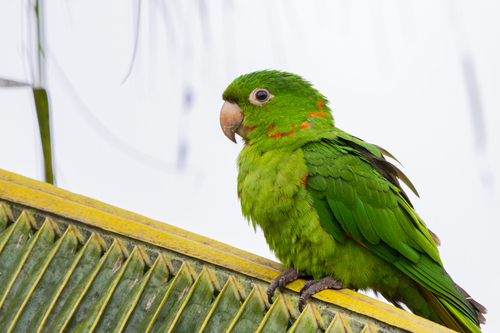
White-eyed Parakeet
Psittacara leucophthalmus
The White-eyed Parakeet is a splash of tropical brilliance, known for its vivid green plumage and its namesake white eye-rings. A social and loud neighbor, this adaptable parrot brings the spirit of the Amazon to backyards across South America.
Quick Identification
Size
Length of 30-34 cm (12-13.4 in); Weight of 100-220 g (3.5-7.8 oz); Wingspan of approximately 55-60 cm (21.6-23.6 in)
Colors
Primary plumage is a vibrant lime green; distinctive white featherless orbital ring; red and yellow underwing coverts; mature birds may show scattered red feathers on the neck and head.
Key Features
- Prominent white featherless ring around each eye
- Red and yellow patches on the bend of the wing and underwings
- Long, pointed tail and heavy, pale-colored beak
- Bright green body with occasional red flecks on the head
When You’ll See Them
Geographic range
Where Does the White-eyed Parakeet Live?
Native to the South American continent, the White-eyed Parakeet enjoys one of the widest distributions of any New World parrot. It is a resident across nearly every mainland country, stretching from the northern reaches of Colombia and Venezuela down through the Amazon basin into northern Argentina and Uruguay. While they are famously absent from Chile and the high Andes, they have successfully established themselves on the island of Trinidad and have several thriving introduced populations in major South American metropolitan areas.
Basemap © OpenStreetMap contributors
Behavior
White-eyed Parakeets are highly social and energetic birds that are almost always found in pairs or noisy flocks. In the wild, these groups can range from a few dozen to hundreds of individuals, especially at communal roosting sites in palm groves or cliff faces. They are known for their loud, raucous calls that can be heard from a great distance as they fly between feeding grounds and nesting sites.
In urban and suburban environments, these parakeets have proven remarkably adaptable. They often lose some of their natural wariness toward humans, frequenting backyard bird feeders and city parks. They are intelligent and inquisitive, often engaging in complex social grooming (allopreening) and play behavior within their flocks. Their flight is fast and direct, characterized by rapid wingbeats.
EverydayEarth exclusive
Camera Tips
To capture the White-eyed Parakeet on an AI-powered backyard camera, placement is everything. These birds are arboreal and rarely descend to the ground, so avoid low-level mounts. Instead, secure your camera 6 to 10 feet high, angled toward a sturdy branch of a fruit-bearing tree or a elevated birdbath. They are particularly attracted to water in dry weather, and a dripping water feature can be an irresistible lure for a thirsty flock.
Because these parakeets move in fast-acting groups, set your camera to a multi-shot burst mode or high-quality video. Their bright green feathers can sometimes 'wash out' in direct midday sun, so positioning the camera to face north or south—avoiding direct east-west glare—will help preserve the rich color detail and the subtle red flecks on their plumage. If you are using a trigger-based camera, ensure the sensitivity is high enough to catch their rapid landing approach.
In terms of baiting, they are most attracted to native palms, sunflower seeds, or fresh fruit like sliced papaya and apples. If you have a platform feeder, mount the camera about 3 feet away at eye level with the feeder. Early morning is the 'golden hour' for White-eyed Parakeets; they are most vocal and active just after sunrise as they leave their roosts to find breakfast. During the breeding season, look for them investigating hollow tree cavities, which provide excellent opportunities for long-term monitoring.
Similar Species
Species that look similar or are commonly confused with White-eyed Parakeet.
Frequently Asked Questions
Record White-eyed Parakeet at your habitat
Connect a camera to start building your own species record — AI identifies every visitor automatically.