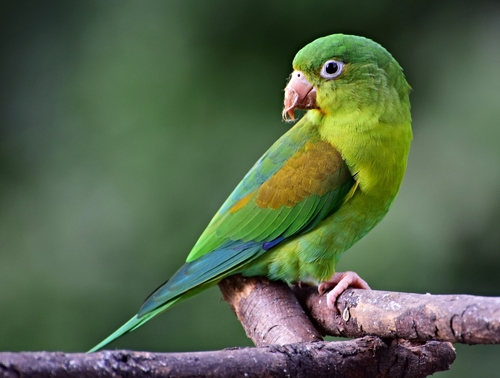
Orange-chinned Parakeet
Brotogeris jugularis
Meet the vibrant and chatty socialite of the Neotropical suburbs. With its brilliant green plumage and a hidden flash of orange, this parakeet turns every backyard visit into a lively party.
Quick Identification
Size
Length of 17–18 cm (6.7–7 inches); wingspan of approximately 28 cm (11 inches); weight between 55–65 g (1.9–2.3 oz)
Colors
Primary plumage is a vibrant lime green; features a small, signature orange patch under the lower mandible and bronze-brown wing coverts. Males and females are monomorphic (look identical).
Key Features
- Small triangular orange patch under the chin
- Bronze-brown shoulder or 'mantle' patches
- Short, pointed wedge-shaped tail
- Loud, rhythmic 'tovi-tovi' screeching calls
When You’ll See Them
Geographic range
Where Does the Orange-chinned Parakeet Live?
Native to the tropical Americas, the Orange-chinned Parakeet claims a massive territory stretching from the Pacific lowlands of southern Mexico through the heart of Central America. It is a common sight throughout the coastal regions of Guatemala, El Salvador, Honduras, Nicaragua, Costa Rica, and Panama, extending its reach into the northern lowlands of Colombia and Venezuela. While primarily a mainland resident, small introduced populations have occasionally been reported in South Florida, though they are most iconic as a staple of Neotropical urban and rural landscapes.
Basemap © OpenStreetMap contributors
Behavior
The Orange-chinned Parakeet is an incredibly social and charismatic bird, often seen in large, boisterous flocks that can number in the dozens. They are highly vocal, maintaining constant communication with their mates and group members through a series of rapid-fire chirps and screeches. In the wild, they are frequently observed grooming one another, a behavior that strengthens pair bonds and social hierarchies within the community.
In suburban settings, these parakeets have adapted remarkably well to human presence. They are bold and curious, often visiting backyard gardens that provide ample fruit trees or flowering plants. Unlike some more reclusive parrot species, the Orange-chinned Parakeet is comfortable foraging in plain sight, making them a favorite for backyard birdwatchers. During the breeding season, pairs will often seek out hollowed-out arboreal termite mounds to use as nesting sites, showing a unique ecological relationship with local insects.
EverydayEarth exclusive
Camera Tips
To capture high-quality footage of these fast-moving parakeets, camera placement is everything. Since they are communal feeders, position your camera near a reliable source of fruit, such as a platform feeder stocked with sliced mango, papaya, or overripe bananas. Mount the camera at a height of 5 to 8 feet, ideally facing a branch that serves as a 'staging area' where the birds land before hopping down to the food. This allows you to capture their social interactions and preening behavior rather than just feeding shots.
Lighting is crucial for bringing out the iridescent greens of their feathers. Avoid placing the camera where it will be pointing directly into the morning sun; instead, aim for a north or south-facing orientation to get soft, even light. Because these birds move in bursts and are quite jittery, set your AI camera's trigger speed to its fastest setting and consider a short video burst mode (10–15 seconds). This will help you catch the rapid head movements and the flash of orange on their chins that might be missed in a still photo.
Don't overlook the importance of water. Orange-chinned Parakeets are frequent bathers, especially during the dry season. A elevated bird bath with a small solar fountain can be a magnet for the entire flock. Position the camera about 3 to 4 feet from the water's edge at a slightly downward angle. If your camera supports it, increasing the frame rate to 60fps will allow you to see the spectacular water droplets flying as they splash and flutter their wings in slow motion.
Similar Species
Species that look similar or are commonly confused with Orange-chinned Parakeet.
Frequently Asked Questions
Record Orange-chinned Parakeet at your habitat
Connect a camera to start building your own species record — AI identifies every visitor automatically.