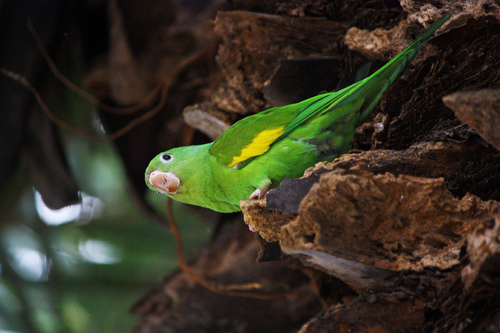
Yellow-chevroned Parakeet
Brotogeris chiriri
A vibrant and vocal gem of the suburbs, the Yellow-chevroned Parakeet brings a splash of tropical green and gold to backyard feeders across the Americas.
Quick Identification
Size
20-25 cm (8-10 inches) long; wingspan of 34-38 cm (13-15 inches); weight 65-80g (2.3-2.8 oz)
Colors
Bright lime-green body with a prominent yellow patch on the leading edge of the wing; pale horn-colored bill and brown eyes
Key Features
- Bright yellow 'chevron' on the wing visible when perched or flying
- Slender, pointed tail
- Pale pinkish-tan or horn-colored bill
- Loud, screeching metallic calls
When You’ll See Them
Geographic range
Where Does the Yellow-chevroned Parakeet Live?
Native to the heart of South America, this resilient parakeet thrives across a massive range from central Brazil and eastern Bolivia down through Paraguay and into northern Argentina. Beyond its native tropical roots, it has successfully colonized urban landscapes in the United States, establishing permanent, self-sustaining populations in the coastal regions of Southern California and Florida. These introduced populations are particularly visible in metropolitan areas like Los Angeles and Miami, where they treat suburban gardens as a secondary jungle.
Basemap © OpenStreetMap contributors
Behavior
Yellow-chevroned Parakeets are highly social and energetic birds that are almost never seen alone. They move in tight-knit flocks, often ranging from pairs to dozens of individuals, and are known for their constant, high-pitched chatter while in flight or feeding. In their native South American range, they are common in woodland edges, but they have become remarkably successful 'urbanites' in North American cities, where they navigate suburban landscapes with ease.
These parakeets are incredibly acrobatic feeders, often hanging upside down to reach seeds, fruits, or blossoms. They have a symbiotic relationship with many ornamental trees in suburban environments, feeding heavily on the nectar and seeds of non-native species. While they can be wary of ground-level activity, they are bold around established bird feeders and often dominate smaller songbirds due to their size and social numbers.
EverydayEarth exclusive
Camera Tips
To capture the Yellow-chevroned Parakeet on camera, focus on their two primary needs: high-energy food and water. These birds are particularly fond of large sunflower seeds and tropical fruits. If you are using a backyard AI camera, mounting it near a platform feeder stocked with black oil sunflower seeds or a suet cage stuffed with fresh apple slices or grapes is your best bet for a clear 'mugshot.'
Placement is critical because these birds are arboreal. Rather than placing your camera on the ground, try mounting it at eye level—approximately 5 to 7 feet high—on a fence post or a tree limb near a bird bath. In dry climates like Southern California, a consistent water source is an irresistible magnet. Position the camera to face the water at a slight downward angle to capture the reflection and the vivid yellow wing markings as they splash.
Because they travel in flocks, parakeet activity can be chaotic and fast. Set your camera to a multi-shot burst mode or high-frame-rate video to ensure you don't just get a green blur. If your camera has adjustable sensitivity, set it to 'High' during the early morning hours (just after sunrise) when the flock is most active and vocal. Look for them in the canopy of exotic trees like Silk Floss or Bottlebrush; if you have these in your yard, aim your camera at a 'staging' branch where they land before descending to a feeder.
Similar Species
Species that look similar or are commonly confused with Yellow-chevroned Parakeet.
Frequently Asked Questions
Record Yellow-chevroned Parakeet at your habitat
Connect a camera to start building your own species record — AI identifies every visitor automatically.