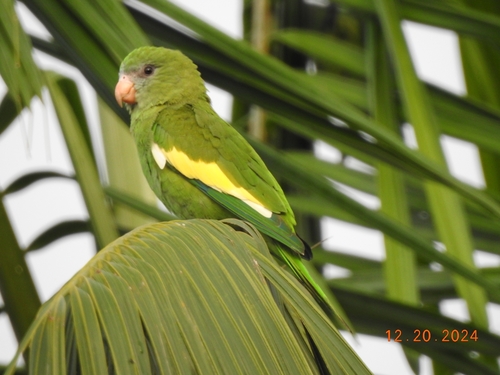
White-winged Parakeet
Brotogeris versicolurus
A social and vocal resident of the Amazon, the White-winged Parakeet has successfully brought its bright green plumage and energetic charm to the suburban gardens of North America.
Quick Identification
Size
21.5–25 cm (8.5–10 in) long; wingspan of approximately 35 cm (13.8 in); weight 65–75 g (2.3–2.6 oz)
Colors
Primary lime-green plumage with a yellow patch on the wing coverts and a prominent white trailing edge on the flight feathers. Pale horn-colored bill and pinkish-tan legs.
Key Features
- Distinctive white and yellow wing patches visible in flight
- Long, slender, pointed tail
- High-pitched, metallic screeching calls
- Small, stocky parrot profile
When You’ll See Them
Geographic range
Where Does the White-winged Parakeet Live?
The White-winged Parakeet is originally native to the expansive Amazon River basin of South America, stretching from southeastern Colombia and eastern Peru through northern Brazil. In recent decades, escapees from the pet trade have established thriving feral populations in the United States, most notably in the coastal urban landscapes of Los Angeles and Miami, as well as throughout Puerto Rico. They are typically found in lowland areas where tropical or subtropical climates provide a steady year-round food supply.
Basemap © OpenStreetMap contributors
Behavior
White-winged Parakeets are intensely social and energetic birds that are almost never seen alone. They move in tight-knit flocks, often ranging from a dozen to over a hundred individuals, communicating with a constant barrage of high-pitched chirps and squawks. In flight, they are fast and direct, showing off their signature wing colors, while on branches, they are acrobatic climbers, using their hooked beaks as a third limb to navigate through dense foliage.
In urban environments, these parakeets have become remarkably bold. They are known to congregate in large communal roosts, often selecting tall palm trees or ornamental evergreens in suburban neighborhoods. They maintain strong pair bonds, and it is common to see two birds sitting closely together, preening each other's head feathers to reinforce their social connection. While wary of predators, they are quite comfortable around human activity, especially where food is readily available.
EverydayEarth exclusive
Camera Tips
To capture the best footage of White-winged Parakeets, position your camera near a high-quality bird feeder or a shallow birdbath. Since these birds are arboreal, mounting your camera at head height (5-7 feet) on a tree trunk or pole facing a platform feeder will provide a much better angle than ground placement. They are particularly attracted to black oil sunflower seeds and fresh fruit like sliced apples, which can act as a great lure to keep them in the camera's frame for longer periods.
Lighting is critical for these birds because their bright green feathers and white wing patches can easily 'wash out' in harsh midday sun. Aim your camera to face north or south to avoid direct glare, or place it in an area with dappled sunlight. Because they move in fast, jittery bursts, use a camera with a high trigger speed and set it to take 3-5 photos per burst or record 10-second video clips to ensure you catch their rapid social interactions.
Timing is everything with this species. They are most active shortly after sunrise as they leave their roosts to forage, and again in the late afternoon before returning to sleep. If you have an AI-powered camera, look for 'Green' or 'Small Bird' filters, but be prepared for a lot of activity—when one White-winged Parakeet arrives, the whole flock usually follows, which can lead to hundreds of trigger events in a single morning.
Similar Species
Species that look similar or are commonly confused with White-winged Parakeet.
Frequently Asked Questions
Record White-winged Parakeet at your habitat
Connect a camera to start building your own species record — AI identifies every visitor automatically.