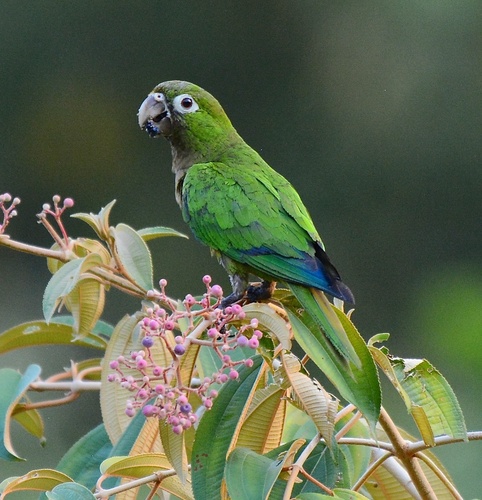
Olive-throated Parakeet
Eupsittula nana
A social and spirited resident of the tropical lowlands, the Olive-throated Parakeet is known for its earthy olive plumage and its fascinating habit of nesting in termite mounds. Whether screaming across the sky or quietly munching on figs, these parakeets bring a vibrant touch of the tropics to any backyard.
Quick Identification
Size
22–26 cm (8.5–10 in) long; weight approximately 75–85 g (2.6–3 oz)
Colors
Primary green body with a dull olive-brown throat and breast; blue-edged flight feathers; yellowish under-tail
Key Features
- Dull olive-brown throat and chest
- Distinct white ring of bare skin around the eye
- Long, pointed green tail
- Green upperparts with blue on the wing primaries
When You’ll See Them
Geographic range
Where Does the Olive-throated Parakeet Live?
Native to the tropical regions of North and Central America, the Olive-throated Parakeet's range stretches from eastern Mexico down through Belize, Guatemala, and Honduras to western Costa Rica. A distinct subspecies is endemic to the island of Jamaica, where it is a widespread resident. Additionally, a successful introduced population has become established in the Dominican Republic on the island of Hispaniola.
Basemap © OpenStreetMap contributors
Behavior
Olive-throated Parakeets are gregarious and highly social birds, typically found in pairs or small flocks of 6 to 30 individuals. They are famously boisterous in flight, emitting sharp, screeching calls that reveal their presence long before they are seen. However, once they land to feed in the canopy, they become remarkably silent and difficult to spot, using their green plumage as effective camouflage against the leaves.
These parakeets are known for their unique nesting habits, often excavating cavities within active arboreal termite mounds. This provides a stable environment and protection from predators. In suburban settings, they are adaptable and can become quite bold around humans, especially when attracted by fruiting trees or backyard bird feeders, where they display a mix of curiosity and cautious agility.
EverydayEarth exclusive
Camera Tips
To successfully capture the Olive-throated Parakeet on your backyard camera, focus on elevation. These birds are canopy-dwellers and rarely descend to the ground. Position your camera 10 to 15 feet high, aiming at fruiting trees such as fig, guava, or citrus. If you use a bird feeder, mount it high and ensure the camera is angled slightly downward from an adjacent branch to capture the bird's distinctive olive throat and chest markings.
Luring them requires consistency. Fresh fruit slices like papaya or mango are highly effective, as are large sunflower seeds. Because these parakeets move in fast, energetic bursts, set your camera to a fast shutter speed or 'Sports Mode' to prevent motion blur. Using a trigger interval of 5-10 seconds will help you capture the social interactions of the flock without filling your SD card too quickly with identical frames.
Pay attention to the 'Golden Hour'—the first two hours after sunrise and the last two before sunset. This is when they are most active and vocal. If your camera allows for video, use it; the social bickering and grooming behavior of a pair of Olive-throated Parakeets is much more engaging than a still photo. If you live in an area with arboreal termite mounds, placing a camera nearby during the spring nesting season can yield rare footage of their unique excavating behavior.
Similar Species
Species that look similar or are commonly confused with Olive-throated Parakeet.
Frequently Asked Questions
Record Olive-throated Parakeet at your habitat
Connect a camera to start building your own species record — AI identifies every visitor automatically.