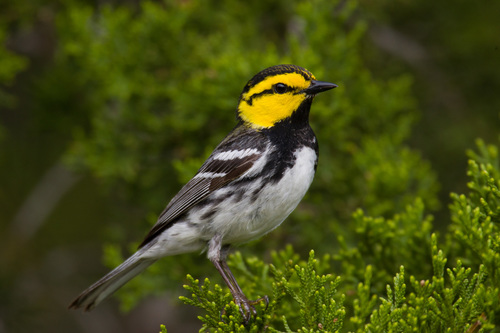
Golden-cheeked Warbler
Setophaga chrysoparia
Meet the only bird that calls Texas its exclusive breeding home. With its brilliant yellow face and striking black markings, the Golden-cheeked Warbler is a rare crown jewel of the Hill Country.
Quick Identification
Size
Length: 12-13 cm (4.7-5.1 in); Wingspan: 20 cm (7.9 in); Weight: 9-11 g (0.3-0.4 oz)
Colors
Brilliant golden-yellow cheeks, black crown, throat, and back. White underparts with black streaking on the flanks. Females are duller with more olive-green on the back.
Key Features
- Brilliant golden-yellow cheeks with a thin black line through the eye
- Solid black throat and upper breast in males
- Dependence on peeling bark from mature Ashe juniper trees
- White wing bars and white outer tail feathers
When You’ll See Them
Geographic range
Where Does the Golden-cheeked Warbler Live?
The Golden-cheeked Warbler is a true Texas icon, holding the distinction of being the only bird species with a breeding range entirely endemic to the state of Texas. It is found exclusively in the juniper-oak woodlands of the Edwards Plateau and the Texas Hill Country during the spring and summer. When autumn arrives, these birds undertake a long-distance migration south through the mountains of Mexico to their wintering grounds in the pine-oak forests of Guatemala, Honduras, and Nicaragua.
Basemap © OpenStreetMap contributors
Behavior
The Golden-cheeked Warbler is an energetic but secretive songbird, best known for its buzzy, rhythmic song that rings through the canyons of Central Texas each spring. They are highly territorial during the breeding season, with males vigorously defending their patches of oak-juniper woodland. Most of their time is spent high in the canopy, where they move with agility among the branches, gleaning insects from the undersides of leaves.
Unlike many other warblers that might forage in mixed flocks, the Golden-cheeked Warbler is often seen in pairs or as solitary individuals during the nesting period. They are particularly famous for their specific nesting requirements; females will only build nests using long strips of bark from mature Ashe juniper trees, woven together with spider webs. Because they are shy and prefer dense cover, they are rarely seen in open areas or low to the ground.
EverydayEarth exclusive
Camera Tips
Capturing the Golden-cheeked Warbler on a backyard camera requires a strategic approach because of their arboreal nature. The most effective way to bring them within camera range is through a water feature. They are highly attracted to the sound of moving or dripping water. Place your camera near a bird bath that includes a dripper or a small waterfall, ensuring the lens is positioned roughly 3 to 5 feet from the water source for a clear, detailed shot.
Because these birds are small and move with sudden, jerky motions, your camera settings are crucial. Use a camera with a very fast trigger speed—0.3 seconds or less—and set the video resolution to 4K if possible. High frame rates (60 fps) are ideal for capturing the fast wing-beats and the vibrant yellow of their cheeks without motion blur. Early morning is the prime time for activity; aim your camera to take advantage of the soft morning light, which highlights their colors better than the harsh midday sun.
Since this is an endangered species, placement is key to avoid disturbance. Position your camera in a quiet, low-traffic area of your yard that borders mature trees. In Texas, the best window for photography is from mid-March to June. Look for areas where mature Ashe junipers are present, as you might capture unique footage of females stripping bark for their nests. Avoid using any playback calls to lure them, as this can cause unnecessary stress to the birds during their sensitive nesting period.
Similar Species
Species that look similar or are commonly confused with Golden-cheeked Warbler.
Frequently Asked Questions
Record Golden-cheeked Warbler at your habitat
Connect a camera to start building your own species record — AI identifies every visitor automatically.