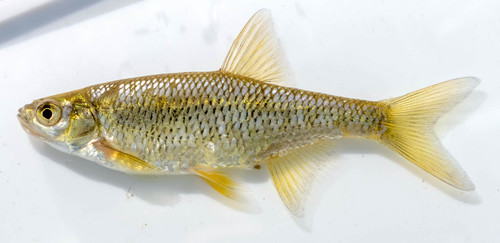
Golden Shiner
Notemigonus crysoleucas
A shimmering resident of North America's quiet waters, the Golden Shiner is famous for its brilliant metallic scales and social schooling behavior.
Quick Identification
Size
3 to 5 inches (7.5 to 12.5 cm) on average, though they can reach 10 to 12 inches (25 to 30 cm) in ideal conditions; weight is typically under 1 lb (0.45 kg).
Colors
Adults feature a brilliant metallic gold or brassy sheen on their sides with olive-green backs; juveniles are more silvery with a dark horizontal stripe along the side.
Key Features
- Deep, slab-sided body shape
- Sharply downward-curving lateral line
- Scaleless 'keel' on the belly between the pelvic fins and anus
- Small, upturned mouth with no barbels
When You’ll See Them
Geographic range
Where Does the Golden Shiner Live?
The Golden Shiner is native to the eastern half of North America, stretching from the Atlantic coast as far west as the Dakotas and Texas. Its core range includes the eastern United States and southeastern Canada, particularly across provinces like Quebec, Ontario, and Manitoba. Due to its extreme popularity as a bait fish, humans have introduced this species to various water bodies in the western United States, where it has established self-sustaining populations.
Basemap © OpenStreetMap contributors
Behavior
Golden Shiners are highly social, schooling fish that prefer the quiet, still waters of ponds and lakes. They are known for their 'cruising' behavior, moving in coordinated groups through aquatic vegetation to forage for food. This schooling behavior provides them with protection against larger predators like Largemouth Bass and Northern Pike, as the shimmering of many golden bodies can confuse a hunter.
These fish exhibit a unique spawning strategy; they often deposit their adhesive eggs on underwater plants, but they have also been observed 'nest-plugging' or laying eggs in the active nests of Largemouth Bass or Bowfin. This allows their offspring to benefit from the protection provided by the larger fish. In backyard settings, they are shy but can become accustomed to human presence if a regular feeding schedule is established.
EverydayEarth exclusive
Camera Tips
To capture the Golden Shiner on camera, you will need an underwater setup or a very clear, top-down view of a shallow pond edge. For the best results, use a waterproof action camera mounted on a weighted tripod or a specialized underwater 'fish cam.' Place the camera near the edge of a weed bed or lily pad field, as these fish rarely venture far from the safety of cover.
Lighting is the biggest challenge underwater. Try to position your camera so the sun is behind it; this will illuminate the fish's scales and produce that iconic golden shimmer. If you are using a backyard pond, a small amount of fish food or breadcrumbs placed in a mesh bag in front of the lens will draw a school into the frame and keep them there for several minutes of footage.
Set your camera to a high frame rate (at least 60fps) if possible. Golden Shiners move with quick, darting motions, and high-speed recording will allow you to see the fluid mechanics of their schooling behavior in slow motion. During the spring spawning season, look for activity around submerged roots or grassy banks where the fish congregate in large numbers.
Similar Species
Species that look similar or are commonly confused with Golden Shiner.
Frequently Asked Questions
Record Golden Shiner at your habitat
Connect a camera to start building your own species record — AI identifies every visitor automatically.