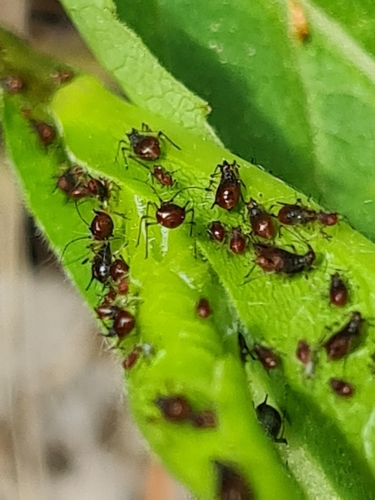
Goldenrod Aphid
Uroleucon solidaginis
With their striking crimson bodies and spindly black legs, Goldenrod Aphids turn ordinary meadow stems into vibrant miniature ecosystems. These tiny 'sap-suckers' are the cornerstone of the backyard food web, attracting a fascinating parade of predators and protectors.
Quick Identification
Size
2–4 mm (0.08–0.16 inches) in length
Colors
Brilliant crimson or brick red body; contrasting long black legs, black antennae, and black cornicles (tailpipes)
Key Features
- Vivid red pear-shaped body
- Extremely long, spindly black legs
- Two prominent black cornicles at the rear
- Aggregated in dense clusters on goldenrod stems
When You’ll See Them
Behavior
Goldenrod Aphids are highly social, gregarious insects that spend the majority of their lives in dense colonies. They are typically found lined up along the tender upper stems of goldenrod plants, usually facing downward. Using their specialized piercing-sucking mouthparts, they tap into the plant's phloem to drink sugary sap. Because this diet is high in sugar but low in nitrogen, they excrete a sticky, sweet liquid called honeydew, which often coats the leaves below them.
These aphids exhibit fascinating defensive behaviors. While they appear stationary, they are sensitive to the vibrations of approaching predators like ladybugs or lacewings. When threatened, an individual may release an alarm pheromone that triggers a collective response, causing the entire colony to drop off the plant and disappear into the thatch below. During the summer, the colony consists almost entirely of females that reproduce through parthenogenesis, effectively cloning themselves to rapidly colonize a host plant.
EverydayEarth exclusive
Camera Tips
Capturing the Goldenrod Aphid requires a macro-capable camera setup because of their diminutive size. If you are using an AI-powered backyard camera, it is essential to position the lens at its minimum focal distance—often between 3 to 8 inches—to get a clear view of the colony. Rather than mounting the camera on the goldenrod itself, which will sway in the wind and cause motion blur, use a separate garden stake or tripod. This stability is crucial for the AI to correctly identify the movement of such small subjects.
Lighting is the most important factor for highlighting their signature red color. Set up your camera on the east or west side of a goldenrod patch to take advantage of side-lighting during the morning or late afternoon. This light passes through their translucent bodies, making them glow against the green stems. Because aphids move very slowly, you can use lower frame rates or time-lapse settings to observe how the colony expands over several days. A 30-second interval time-lapse is perfect for showing the 'ebb and flow' of the colony as individuals move to find fresh sap sites.
To get the most interesting footage, look for 'action' beyond just feeding. Aphid colonies are busy hubs for other wildlife. Keep your camera running to capture ants 'farming' the aphids for honeydew, or predators like the hoverfly larvae and ladybugs moving in for a meal. If you notice winged aphids (alates) appearing in late summer, focus your camera on the tips of the plants, as this is where they will launch into the air to find new host plants. This seasonal transition provides some of the most dynamic footage of an otherwise stationary species.
Similar Species
Species that look similar or are commonly confused with Goldenrod Aphid.
Frequently Asked Questions
Record Goldenrod Aphid at your habitat
Connect a camera to start building your own species record — AI identifies every visitor automatically.