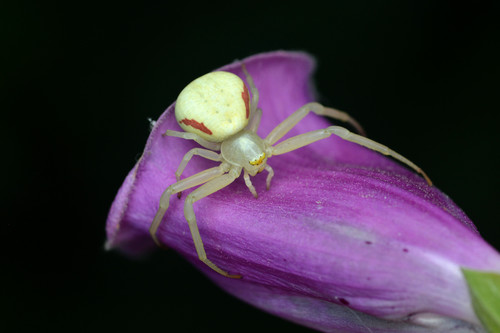
Goldenrod Crab Spider
Misumena vatia
Meet the garden's most sophisticated shapeshifter, a master of camouflage that changes its very color to vanish into the petals of a flower.
Quick Identification
Size
Females: 8–10 mm (0.31–0.39 in); Males: 3–5 mm (0.12–0.20 in)
Colors
Females are white or yellow with optional pink/red abdominal stripes; males are smaller, darker with reddish-brown legs and a white abdomen.
Key Features
- Crab-like ability to walk sideways and backwards
- Reversible color-changing ability (white to yellow)
- First two pairs of legs are longer and held out in a 'grasping' posture
- Broad, flattened cephalothorax with eight small eyes
When You’ll See Them
Sightings on EverydayEarth
Jun 24, 2026
During a quiet night at the nest, an Osprey is settled and resting in the center. In the background, a Great Horned Owl is perched alertly on a wooden post, occasionally turning its head. A spider is also seen crawling across the camera lens, creating a large, blurry silhouette in the upper left of the frame.
Jun 5, 2026
An adult Osprey is seen resting within the nest during the night, while a second Osprey stands guard on a nearby wooden post. In the foreground, a spider crawls across the camera lens, creating a large, blurry silhouette.
May 28, 2026
An Osprey sits alertly in its large stick nest, looking around and shifting its position. A small Goldenrod Crab Spider is seen hitching a ride, crawling across the feathers on the bird's upper back. The surrounding landscape is lush and green under the morning light.
May 26, 2026
Two Ospreys are resting at their nest site during the night. One bird is perched on a wooden post above the nest, while the other is tucked into the center of the stick structure. A spider is seen crawling directly across the camera lens, appearing as a large, blurry silhouette in the foreground.
Geographic range
Where Does the Goldenrod Crab Spider Live?
Native across the Holarctic region, the Goldenrod Crab Spider is widely distributed throughout North America and Europe. In the United States and Canada, it is a common sight in backyard gardens and wild meadows, particularly in the eastern and central regions where goldenrod and milkweed thrive. It is equally prevalent across temperate Europe and Northern Asia, making it one of the most widely recognized crab spiders in the Northern Hemisphere.
Basemap © OpenStreetMap contributors
Behavior
The Goldenrod Crab Spider is a patient ambush predator that eschews the traditional spider web in favor of stealth and camouflage. Known as a 'sit-and-wait' predator, it spends days or even weeks perched on a single flower head, perfectly blending into the petals while waiting for unsuspecting pollinators to land. When an insect like a bee or fly arrives, the spider strikes with lightning speed, seizing the prey with its powerful front legs and delivering a venomous bite to the neck or head.
Perhaps their most remarkable behavior is their ability to change color to match their background. This active camouflage is restricted to adult females and is a slow process; moving from white to yellow takes roughly 10 to 25 days, while moving back to white takes about 5 to 7 days. This physiological change is triggered by visual feedback—if the spider's eyes are covered, it loses the ability to match its surroundings accurately.
EverydayEarth exclusive
Camera Tips
Capturing the Goldenrod Crab Spider on camera requires a different approach than traditional wildlife photography. Because these spiders are small and stationary, they are the perfect subjects for backyard macro setups. Instead of a trail camera, use a digital camera with a macro lens or a high-quality smartphone macro attachment. Focus on a patch of flowers like Goldenrod (Solidago), Daisies, or Milkweed. Since these spiders often stay on the same flower for several days, you can set up a 'stationary studio' once you locate one.
For the best results, place your camera on a tripod and use a narrow aperture (f/8 to f/11) to ensure the entire spider is in focus. Natural daylight is usually sufficient, but a diffused flash can help highlight the subtle textures on the spider's cephalothorax and the fine hairs on its legs. If you are using an AI-powered backyard camera, position it within 6-12 inches of a flower cluster and ensure the 'macro' or 'near-focus' setting is enabled to prevent the background from stealing the focus.
Keep an eye on the wind; even a slight breeze can cause a flower to bob in and out of the focal plane. Use a 'plamp' (plant clamp) or a simple stake to stabilize the specific flower the spider is inhabiting. The best time to photograph them is during peak pollinator hours, as you might catch a high-action 'predation event' where the spider captures a bee twice its size. Look for females on yellow or white flowers—once you find one, it will likely be there the next day, allowing you to document its slow color transformation over a week or more.
Similar Species
Species that look similar or are commonly confused with Goldenrod Crab Spider.
Frequently Asked Questions
Record Goldenrod Crab Spider at your habitat
Connect a camera to start building your own species record — AI identifies every visitor automatically.