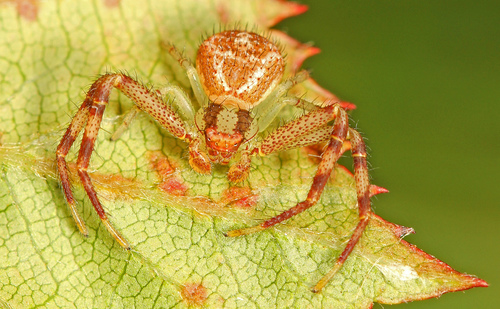
Northern Crab Spider
Mecaphesa asperata
A tiny, bristly master of disguise that hunts the giants of the pollinator world from the petals of your backyard flowers.
Quick Identification
Size
Females are 5–6 mm (0.20–0.24 in) in length; males are significantly smaller at 2–3 mm (0.08–0.12 in).
Colors
Base color ranges from creamy white to bright yellow, often decorated with reddish-brown streaks or a 'V' shape on the abdomen. They are notably more 'hairy' or bristly than similar species.
Key Features
- Two pairs of long front legs held out like crab claws
- Distinctly bristly or 'hairy' texture over the body
- Ability to walk sideways and backwards
- Camouflaged color-shifting to match host flowers
When You’ll See Them
Geographic range
Where Does the Northern Crab Spider Live?
The Northern Crab Spider is widely distributed across North America, ranging from the southern provinces of Canada throughout the entire United States. Its territory extends southward into Mexico, Central America, and several islands within the Caribbean. This species is highly adaptable, thriving in almost any environment where nectar-producing flowers are present, from coastal plains to mountain foothills.
Basemap © OpenStreetMap contributors
Behavior
The Northern Crab Spider is a master of the 'sit-and-wait' predatory tactic. Unlike many spiders, it does not spin a traditional web to catch its prey. Instead, it anchors itself to a flower—often goldenrods, daisies, or sunflowers—and remains perfectly still. Using its remarkable ability to slowly change its body color from white to yellow over several days, it becomes nearly invisible to visiting pollinators.
When an unsuspecting bee, fly, or butterfly lands to feed on nectar, the spider strikes with lightning speed. It uses its powerful, elongated front legs to seize the prey and delivers a venomous bite that quickly immobilizes the insect. Despite their formidable hunting skills, they are completely harmless to humans and are generally shy, retreating to the underside of a leaf if they feel threatened.
EverydayEarth exclusive
Camera Tips
Capturing the Northern Crab Spider on camera requires a dedicated macro approach. Because these spiders are only a few millimeters long, standard trail cameras will likely miss them unless they have a very short focal distance. For AI-powered backyard cameras, position the lens within 6 to 12 inches of a high-traffic 'pollinator' plant, such as Black-eyed Susans or Milkweed. Ensure the camera is stabilized to prevent motion blur during high-magnification captures.
Lighting is your best friend when hunting for these spiders. They are most active during the brightest parts of the day when their prey is out. Position your camera so the sun is behind it or to the side to highlight the spider's bristly texture and the translucent quality of its legs. If your camera allows for focal adjustments, set it to a narrow depth of field to make the spider pop against the floral background.
Don't bother with traditional baits like meat or sugar water; the best 'bait' for a Northern Crab Spider is a healthy, flowering plant. Focus your efforts during the peak of summer. If you find a spider, it is likely to stay on the same flower head for several days, giving you multiple opportunities to refine your camera angle and settings for the perfect shot.
Similar Species
Species that look similar or are commonly confused with Northern Crab Spider.
Frequently Asked Questions
Record Northern Crab Spider at your habitat
Connect a camera to start building your own species record — AI identifies every visitor automatically.