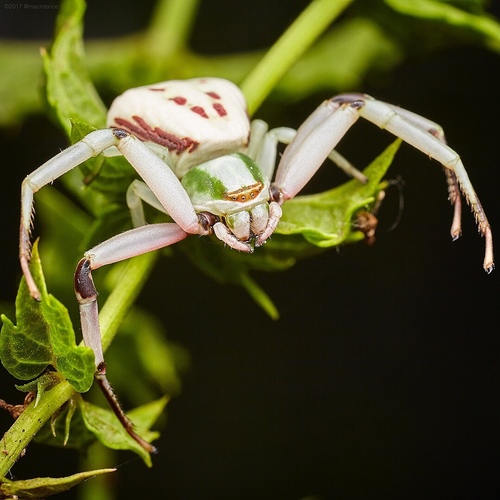
White-banded Crab Spider
Misumenoides formosipes
A pint-sized master of disguise, the White-banded Crab Spider changes its color to vanish into the petals of your backyard flowers.
Quick Identification
Size
Females: 5-11 mm (0.2-0.43 in); Males: 2-4 mm (0.08-0.16 in)
Colors
Females are white or yellow with variable red/brown abdominal streaks; males have dark reddish-brown front legs and a gold abdomen.
Key Features
- Distinct white horizontal ridge across the eye region
- Long, powerful front legs held in an open crab-like posture
- Ability to transition body color between white and yellow
- Flat, wide abdomen with variable markings
When You’ll See Them
Geographic range
Where Does the White-banded Crab Spider Live?
Native to the Americas, the White-banded Crab Spider is widely distributed across the entire United States, from the Atlantic coast to the Pacific Northwest. Its range extends significantly southward through Mexico and Central America, reaching as far as Colombia in South America. It is a highly adaptable species found in nearly every temperate and subtropical environment where flowering plants are present.
Basemap © OpenStreetMap contributors
Behavior
The White-banded Crab Spider is a master of the low-energy hunt. Unlike many other spiders, it does not spin a web to entangle its prey. Instead, it is a sit-and-wait predator that relies on camouflage. By perching atop flowers, it waits for pollinators like bees and butterflies to arrive. When a target gets close enough, the spider uses its exceptionally strong front legs to seize the insect in a lightning-fast strike, delivering a paralyzing bite.
Interestingly, this species exhibits significant sexual dimorphism and territorial guarding. Smaller males will often locate immature females and guard them against rivals, waiting for the female to molt into maturity so they can be the first to mate. Despite their fierce hunting style, these spiders are harmless to humans and are considered beneficial garden residents due to their role in controlling various insect populations.
EverydayEarth exclusive
Camera Tips
Capturing the White-banded Crab Spider on camera requires a specialized approach due to its small size and stationary nature. To get high-quality images or video, you will need a macro lens or a camera with a dedicated macro mode. Position your camera on a sturdy tripod at the same height as the flower heads in your garden. Look for 'hub' flowers—species like Goldenrod, Daisies, or Black-eyed Susans—as these are the spider's preferred hunting grounds.
Because these spiders are ambush predators, they may remain perfectly still for hours. This makes them excellent subjects for time-lapse photography. If you find a female on a flower of a different color (e.g., a white spider on a yellow flower), set your camera to take a photo every 2-4 hours. Over the course of several days, you may capture the fascinating physiological process of the spider changing its body pigment to match its surroundings.
Lighting is the most important technical factor. Because they are often tucked into the shadows of petals, use a ring light or a diffused external flash to fill in the shadows without washing out the delicate patterns on their abdomen. Early morning is the best time for photography; the spiders are often sluggish from the cooler night temperatures and may be covered in dew, which adds a beautiful, crystalline texture to your macro shots.
Similar Species
Species that look similar or are commonly confused with White-banded Crab Spider.
Goldenrod Crab Spider
Lacks the white ridge through the eyes and often has two red stripes on the sides of the abdomen.
Northern Crab Spider
Generally hairier/bristly in appearance with a more mottled brown or green color pattern.
Swift Crab Spider
Usually found on bark or leaves rather than flowers, with a much more elongated body shape.
Frequently Asked Questions
Record White-banded Crab Spider at your habitat
Connect a camera to start building your own species record — AI identifies every visitor automatically.