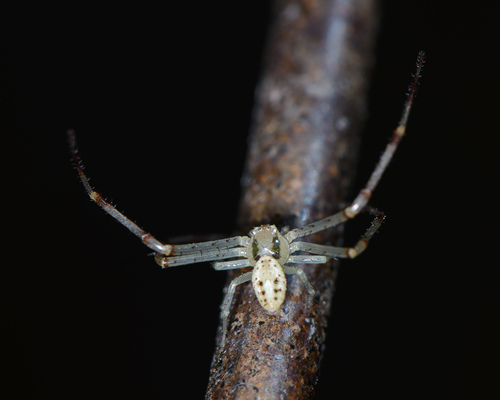
Swift Crab Spider
Mecaphesa celer
A pint-sized powerhouse of the garden, the Swift Crab Spider uses incredible camouflage and lightning-fast reflexes to ambush prey on your favorite flowers.
Quick Identification
Size
Females range from 5 to 7 mm (0.2–0.28 inches); males are significantly smaller, typically 3 to 4 mm (0.12–0.16 inches).
Colors
Base color is usually creamy white to bright yellow; the abdomen often features red or brown V-shaped markings or lateral streaks, while the legs are pale with dark bristles.
Key Features
- Two pairs of long, powerful front legs held in a crab-like pose
- Bristly, hairy appearance on the legs and carapace
- Wide, flattened body shape
- Small black eyes arranged in two rows on a slightly raised mound
When You’ll See Them
Geographic range
Where Does the Swift Crab Spider Live?
The Swift Crab Spider is a widespread native of North America, occurring from the southern provinces of Canada across almost the entire United States. Its range extends deeply into the subtropical regions of Mexico and reaches as far south as Central America, making it one of the most common crab spider species in the Western Hemisphere. They are highly adaptable and can be found in nearly any environment where flowering plants and their pollinators are present.
Basemap © OpenStreetMap contributors
Behavior
The Swift Crab Spider is a master of the sit-and-wait hunting strategy, relying entirely on stealth rather than silk. Unlike orb-weavers, they do not spin webs to catch prey; instead, they use silk only for drop lines or to protect their egg sacs. They are typically found perched atop bright flowers, where they remain motionless for hours, blending into the petals while waiting for pollinators to land within reach of their powerful front legs.
When a target—often a bee or butterfly much larger than the spider itself—gets close, the spider strikes with lightning speed. It seizes the prey with its front legs and delivers a potent, fast-acting venomous bite. These spiders are solitary and highly territorial over their chosen flower; they may even chase away other spiders to maintain control over a prime hunting spot. While they are aggressive hunters, they are harmless to humans and generally flee if disturbed by a gardener.
EverydayEarth exclusive
Camera Tips
Capturing high-quality footage of the Swift Crab Spider requires a different approach than filming larger backyard visitors. Because these spiders are small and relatively stationary, you should use a camera with a macro lens or a high-resolution close-up setting. Focus your lens specifically on the center or the upper petals of 'landing pad' flowers like Black-eyed Susans, Zinnias, or Daisies. These spiders prefer bright, sunny spots, so position your camera to take advantage of natural light, which will also allow for a faster shutter speed to freeze the action when the spider strikes.
Since the Swift Crab Spider is a sit-and-wait predator, motion-trigger sensitivity must be set to its highest level. However, wind can cause flowers to sway, leading to hundreds of empty 'false' triggers. To avoid this, use a small garden stake to gently steady the flower you are filming, or set your camera to a time-lapse mode with short intervals (every 5-10 seconds). This ensures you capture the entire sequence of a hunt, from the initial ambush to the long period spent feeding on the prey.
Place your camera at the height of the flower heads, typically 12 to 36 inches off the ground. For the best results, look for flowers that already show signs of spider activity, such as small silk strands or the discarded husks of flies and bees on the leaves below. Early morning is the ideal time to set up your gear; the spiders are less active in the cooler temperatures, allowing you to frame your shot perfectly before the sun warms them up for the day's hunt.
Similar Species
Species that look similar or are commonly confused with Swift Crab Spider.
Frequently Asked Questions
Record Swift Crab Spider at your habitat
Connect a camera to start building your own species record — AI identifies every visitor automatically.