Goldenrod Leafminer
Microrhopala vittata
Look closely at the goldenrod in your garden and you might spot this tiny, metallic gem. The Goldenrod Leafminer is a striking striped beetle that lives its entire life within the world of a single plant species.
Quick Identification
Size
Adults typically measure 5–7 mm (0.2–0.28 inches) in length.
Colors
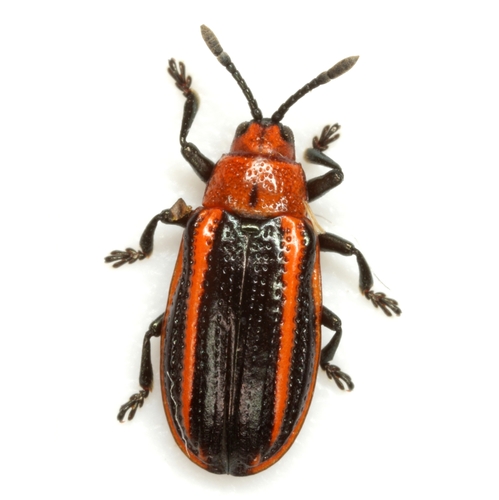
Metallic black, dark bronze, or deep blue-green body with two bold, longitudinal orange or reddish-orange stripes on the wing covers (elytra).
Key Features
- Oblong, flattened body with a distinctly pitted or punctured texture
- Two prominent orange-red stripes running down the back
- Found almost exclusively on goldenrod (Solidago) plants
- Antennae are short and thickened toward the tips
When You’ll See Them
Behavior
The Goldenrod Leafminer is a specialized beetle that spends its entire life cycle in close association with goldenrod plants. In the spring, adults emerge from the leaf litter to feed on the leaf surfaces, creating a 'skeletonized' look where only the veins remain. They are relatively docile and slow-moving, often found basking on the upper side of leaves during sunny mornings.
The species is most famous for its larval stage. Females deposit eggs on the leaves, and once the larvae hatch, they bore directly into the leaf tissue. Unlike many insects that eat the whole leaf, these larvae live *inside* the leaf, eating the nutrient-rich interior while leaving the top and bottom layers intact. This creates visible, brown, blister-like 'mines' that protect the growing larvae from predators and harsh weather.
EverydayEarth exclusive
Camera Tips
Capturing the Goldenrod Leafminer requires a shift in perspective, as these beetles are quite small. To get a clear shot, you should position your camera close to a patch of goldenrod. If your AI-powered camera has a macro or close-up mode, now is the time to use it. Place the camera about 6 to 12 inches away from the top third of the plant, as this is where the beetles are most active during the early summer.
Because these insects are too small to trigger traditional PIR (Passive Infrared) motion sensors used in trail cams, you should use 'Time Lapse' or 'Scheduled Capture' modes. Set the camera to take a photo every 5 to 10 minutes during the warmest part of the day. If your camera supports AI-based insect detection, ensure the sensitivity is set to high and the focal point is locked on a specific leaf where you've noticed feeding damage (brown spots or skeletonized holes).
Lighting is your best friend when filming metallic beetles. Position your camera so the sun is behind it, hitting the beetle's back. This will highlight the brilliant contrast between the metallic dark blue and the bright orange stripes. Avoid days with heavy wind, as the goldenrod stems will sway too much, resulting in blurry images or the beetle being moved out of the frame. A calm, sunny morning after the dew has dried is the optimal time for the sharpest, most vibrant captures.
For the best variety, don't just focus on the adults. Aim your camera at the leaves with brown, puffy 'mines' later in the summer. You might catch the moment a newly transformed adult emerges from the leaf, or capture predatory insects like wasps investigating the mines. Since they don't move fast, you can take your time with framing and composition to get that perfect 'National Geographic' style backyard shot.
Similar Species
Species that look similar or are commonly confused with Goldenrod Leafminer.
Frequently Asked Questions
Record Goldenrod Leafminer at your habitat
Connect a camera to start building your own species record — AI identifies every visitor automatically.