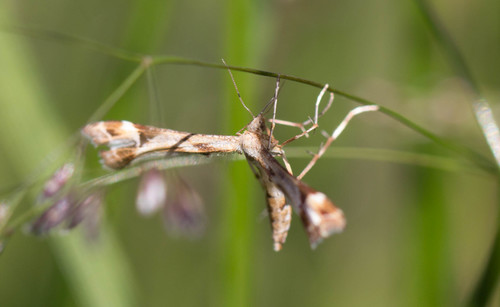
Goldenrod Plume Moth
Platyptilia calodactyla
With wings like delicate feathers and a unique T-shaped silhouette, the Goldenrod Plume Moth is a master of garden camouflage. This tiny aeronaut is a summer staple for backyard observers across Eurasia.
Quick Identification
Size
Wingspan of 18–25 mm (0.7 to 1.0 inches); body length approximately 10–12 mm.
Colors
Warm ochreous to reddish-brown with white transverse lines and a distinct dark brown triangular mark on the leading edge of the forewings.
Key Features
- Distinctive T-shaped resting posture
- Deeply cleft (divided) wings with feathery edges
- Dark triangular mark on the costal margin
- Long, slender legs with hairy spurs
When You’ll See Them
Geographic range
Where Does the Goldenrod Plume Moth Live?
The Goldenrod Plume Moth is a native resident of the vast temperate stretches of Eurasia. Its core range spans from the United Kingdom and across nearly all of Continental Europe, extending northward into Scandinavia and southward to the Mediterranean. To the east, its presence continues through the temperate regions of Russia, reaching into parts of China and Japan, making it one of the more widely distributed plume moths in the Northern Hemisphere.
Basemap © OpenStreetMap contributors
Behavior
While primarily crepuscular and nocturnal, these moths are easily flushed from vegetation during the day. They are relatively weak fliers, usually making short, fluttering hops from one plant to another rather than sustained long-distance flights. In the backyard, you will most likely observe them hanging motionless on the underside of leaves or perched prominently on the flower heads of their namesake host plants during the evening hours.
EverydayEarth exclusive
Camera Tips
Since they are most active during low-light hours, use a camera with a good 'night vision' or infrared mode. However, for the best color detail of their ochreous wings, an external white light or a specialized moth trap light can be used to draw them toward your lens. If using an AI-powered trail camera, ensure the sensitivity is set to high, as the thin profile of a plume moth may not always trigger standard motion sensors. Positioning the camera to look slightly upward at the underside of leaves can also yield great shots of them resting during the day.
Timing is critical; in most of their range, the adults are only on the wing from late June through August. During this window, calm, humid nights are the best for activity. Set your camera to take 'burst' photos or short video clips, as the moths often adjust their T-pose slightly after landing, providing different angles of their intricate, feathered wing structure. If you are using a manual setup, a fast shutter speed is less important than a deep depth of field (higher f-stop), as their wide wingspan can easily fall out of focus if the focal plane is too thin.
Similar Species
Species that look similar or are commonly confused with Goldenrod Plume Moth.
Frequently Asked Questions
Record Goldenrod Plume Moth at your habitat
Connect a camera to start building your own species record — AI identifies every visitor automatically.