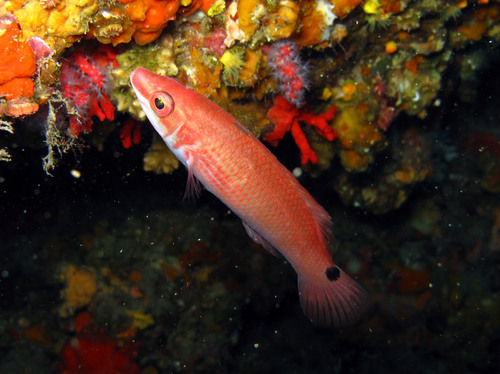
Goldsinny Wrasse
Ctenolabrus rupestris
A small, vibrant resident of European rocky shores, the Goldsinny Wrasse is easily identified by the unique 'twin spots' on its tail and fin.
Quick Identification
Size
Usually 10–15 cm (4–6 inches) in length, with rare individuals reaching up to 20 cm (8 inches).
Colors
Typically orange-red, pinkish, or reddish-brown with a pale belly; features a prominent black spot on the upper tail base and another at the front of the dorsal fin.
Key Features
- Distinctive black spot on the upper side of the tail base (caudal peduncle)
- Small black spot at the very front of the dorsal fin
- Relatively slender body with a pointed snout and small mouth
- Continuous dorsal fin running along the back
When You’ll See Them
Geographic range
Where Does the Goldsinny Wrasse Live?
The Goldsinny Wrasse is native to the eastern Atlantic Ocean, where it thrives in the temperate coastal waters of Europe and North Africa. Its core range spans from the Norwegian fjords and the British Isles down to the Mediterranean and Black Seas, occasionally reaching as far south as Morocco. This species is a permanent resident throughout its range, clinging to rocky shorelines and protected bays rather than venturing into the open ocean.
Basemap © OpenStreetMap contributors
Behavior
The Goldsinny Wrasse is a busy, diurnal fish that is most active during the bright daylight hours. It is a highly territorial species, especially the males, which often defend small crevices or patches of seaweed from intruders. Unlike larger wrasse species that may wander across large reef systems, the Goldsinny tends to stay close to its chosen home, darting into rocky cracks at the first sign of danger.
In the wider marine ecosystem, this species is noted for its occasional role as a cleaner fish, picking parasites and dead skin off larger fish. This behavior has made them valuable in sustainable aquaculture, where they are used to naturally manage sea lice. While they are generally solitary or found in loose aggregations near food sources, they are not particularly aggressive toward humans and can be quite inquisitive around underwater cameras if approached slowly.
EverydayEarth exclusive
Camera Tips
To capture the Goldsinny Wrasse on an underwater camera, focus on transition zones where rocky outcrops meet seaweed or kelp forests. Use a weighted camera mount or a small tripod secured with dive weights to keep the frame steady against the coastal surge. Position the camera about 2 feet away from a known crevice or a patch of lush seaweed, as these fish are 'homebodies' that rarely venture far into open sandy areas.
Using a scent-based lure is the most effective way to bring them into the frame. A small mesh bait bag filled with crushed shore crabs or chopped-up mussels works wonders. Secure the bait bag just out of the center of the frame to encourage the fish to stay within the shot while they investigate. Because they are most active when the sun is high, timing your recording for midday will provide the best natural light to showcase their vibrant orange and red scales.
For the best clarity, try to deploy your camera during a period of high tide and low wind. High tide often brings in clearer, more oxygenated water, which reduces the 'backscatter' of sand and silt in your footage. If your camera allows, set it to a high frame rate like 60fps; Goldsinny Wrasse move with quick, flicking motions of their fins that can look blurry at lower frame rates.
Similar Species
Species that look similar or are commonly confused with Goldsinny Wrasse.
Frequently Asked Questions
Record Goldsinny Wrasse at your habitat
Connect a camera to start building your own species record — AI identifies every visitor automatically.