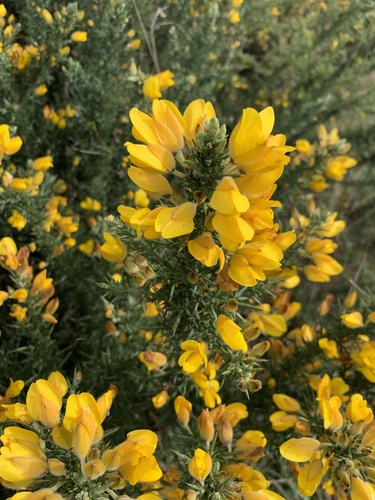
gorse
Ulex europaeus
A resilient, gold-bloomed evergreen that thrives where other plants fail, Gorse is a vital sanctuary for songbirds and a staple of the wild European coastline.
Quick Identification
Size
A dense shrub typically reaching 1.5–3 meters (5–10 ft) in height and spread, often forming impenetrable thickets.
Colors
Bright yellow flowers; dark green to grey-green stems and spines; brown to black seed pods.
Key Features
- Branches covered in sharp, stiff green spines instead of traditional leaves
- Bright yellow, pea-shaped flowers with a distinct coconut scent
- Explosive seed pods that turn black when ripe
When You’ll See Them
Geographic range
Where Does the gorse Live?
Common gorse is native to the Atlantic coast of Western Europe, with its primary range extending across the United Kingdom, Ireland, France, Spain, and Portugal. Due to its resilience, it has been widely introduced and is now established across North America, New Zealand, Australia, and parts of South America. It thrives best in temperate maritime climates where winters are relatively mild and the air is humid.
Basemap © OpenStreetMap contributors
Behavior
Common gorse is a remarkably hardy evergreen shrub known for its aggressive growth and ability to dominate landscapes. As a nitrogen-fixer, it possesses specialized root nodules that house bacteria to convert atmospheric nitrogen into soil nutrients, allowing it to flourish in poor, acidic, or sandy soils where other plants struggle. This makes it a pioneer species, often the first to reclaim disturbed ground or coastal cliffs.
The plant is famous for its extreme flammability; the combination of high oil content in its needles and the accumulation of dry, dead wood in the center of the bush creates a significant fire risk. Paradoxically, gorse has evolved to thrive after fire, using the heat to trigger the germination of its long-lived seeds. In the ecosystem, it serves as a crucial 'nursery' plant, providing year-round shelter and nesting sites for small birds and a vital nectar source for bees during the lean winter months.
EverydayEarth exclusive
Camera Tips
When photographing gorse with a backyard or trail camera, the primary goal is often to capture the wildlife that uses the shrub for protection. Position your camera on a sturdy tripod or mount it to a nearby fence post, aiming at a clear 'opening' or branch where birds like Stonechats or Linnets are likely to perch. Because gorse is very rigid, it makes an excellent natural tripod for lightweight cameras, though you must be careful of the spines.
To capture the vibrant yellow of the flowers without overexposing the image, try to photograph during the 'golden hours' of early morning or late afternoon. The soft light enhances the waxy texture of the petals and the deep greens of the spines. If your camera has a macro mode, use it to get close-up shots of the flowers; you might catch the fascinating moment a bee 'trips' the flower mechanism to release pollen.
For those interested in the plant's lifecycle, time-lapse photography is highly effective. Set your camera to take one photo every few hours during the spring to document the 'golden tide' as the bush transitions from green to bright yellow. If you are using a motion-triggered trail camera, set the sensitivity to 'Medium' or 'Low' if it's a windy day, as the swaying of the spiny branches can cause hundreds of false triggers.
Similar Species
Species that look similar or are commonly confused with gorse.
Frequently Asked Questions
Record gorse at your habitat
Connect a camera to start building your own species record — AI identifies every visitor automatically.