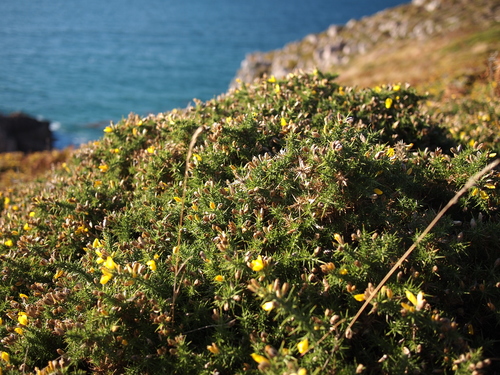
Western Gorse
Ulex gallii
A golden icon of the Atlantic fringe, Western Gorse paints the heathlands yellow from late summer to autumn, providing a prickly fortress for coastal wildlife.
Quick Identification
Size
Height of 50–150 cm (20–60 inches); spread can reach 1–2 metres (3–6 feet)
Colors
Bright golden-yellow flowers; dark olive-green stems and rigid, needle-like spines
Key Features
- Sharp, rigid spines instead of true leaves
- Deep yellow pea-like flowers blooming late summer to autumn
- Dense, low-growing mounded habit
- Strong coconut-like fragrance in direct sunlight
When You’ll See Them
Geographic range
Where Does the Western Gorse Live?
Western Gorse is a specialist of the Atlantic coastlines of Western Europe. It is natively distributed across the United Kingdom—primarily in Wales, South-west England, and parts of Scotland—as well as the entirety of Ireland and the Isle of Man. Its range extends south along the western coast of France and into the northern 'Green Spain' region along the Bay of Biscay, where it thrives in the mild, humid maritime climate.
Basemap © OpenStreetMap contributors
Behavior
Western Gorse is a rugged, evergreen shrub that acts as a foundational species in maritime heathland ecosystems. Unlike its taller relative, Common Gorse, which flowers in the spring, Western Gorse provides a vital late-season burst of energy for the environment, blooming from mid-summer well into the autumn. It grows in dense, prickly cushions that are nearly impenetrable to larger animals, creating a safe sanctuary for smaller creatures.
The plant has a symbiotic relationship with nitrogen-fixing bacteria in its root nodules, allowing it to thrive in the nutrient-poor, acidic soils typical of moorlands and coastal cliffs. By enriching the soil, it paves the way for other plant successions. For humans, it is a hallmark of the Atlantic landscape, though its formidable spines require sturdy footwear and thick trousers for anyone venturing off-path.
EverydayEarth exclusive
Camera Tips
When setting up a camera to observe the life within Western Gorse, focus on the 'edge' effect. Because the shrub is so dense and prickly, many species use it as a fortress. Position your camera on a tripod or stake about 30 cm (1 foot) off the ground, aimed at an opening or a 'run' leading into the base of the gorse. This is an excellent way to capture footage of small mammals like wood mice or bank voles, and even reptiles like common lizards that bask on the outer spines.
To capture the birds that rely on Western Gorse, such as the Stonechat or the rare Dartford Warbler, place your camera roughly 2 metres away from a prominent, tall spray of the plant. These birds often use the highest spines as 'song posts' or lookouts. Ensure your camera has a fast trigger speed, as these birds move quickly. If your camera allows for video, set it to 15-second clips to capture the fascinating social interactions and feeding behaviors of these heathland specialists.
Be mindful of the wind. Gorse spines are light and move easily in the breeze, which can lead to hundreds of 'false triggers' on PIR-based cameras. To avoid this, clear any very close, loose branches from the immediate foreground of the lens and set your camera's sensitivity to 'Medium'. If you are looking for nocturnal activity, Western Gorse is a hotspot for moths; a camera with a high-quality infrared flash will allow you to see the nighttime visitors without disturbing the local wildlife.
Similar Species
Species that look similar or are commonly confused with Western Gorse.
Frequently Asked Questions
Record Western Gorse at your habitat
Connect a camera to start building your own species record — AI identifies every visitor automatically.