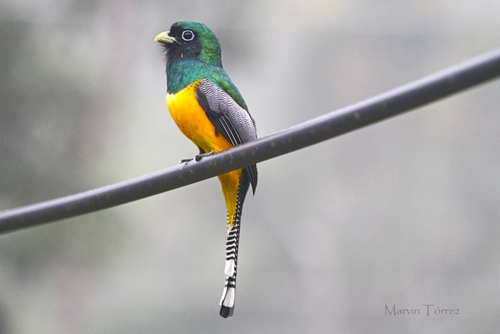
Graceful Black-throated Trogon
Trogon tenellus
A jewel of the humid lowlands, the Graceful Black-throated Trogon blends vibrant yellow and metallic green into the dappled shade of the rainforest. This master of stillness wait for the perfect moment to strike, making it a rewarding challenge for any backyard wildlife observer.
Quick Identification
Size
23–25 cm (9–10 in) in length; weighs approximately 50–60 g (1.8–2.1 oz)
Colors
Males have a metallic green head and back, a black throat, and a bright yellow belly; females are warm brown where males are green.
Key Features
- Bright yellow belly and vent
- Metallic green upperparts on males
- Fine black-and-white horizontal barring on the undertail
- Pale blue or white eye-ring
- Distinctive black throat mask
When You’ll See Them
Geographic range
Where Does the Graceful Black-throated Trogon Live?
The Graceful Black-throated Trogon is native to the lush tropical corridors of Central America and the northern edge of South America. Its core range extends from southeastern Honduras through Nicaragua, Costa Rica, and Panama, reaching its southern limit in northwestern Colombia. It is a dedicated lowland species, rarely found in high-altitude cloud forests, preferring the humid evergreen environments of the Caribbean and Pacific slopes.
Basemap © OpenStreetMap contributors
Behavior
The Graceful Black-throated Trogon is a classic "sit-and-wait" predator of the tropical forest understory. It is known for its remarkable patience, often sitting perfectly still on a mid-level branch for several minutes at a time. This upright, motionless posture, combined with its habit of perching in the shade, makes it surprisingly difficult to spot despite its vivid yellow and green plumage.
When it spots prey, the trogon performs a sudden, acrobatic sally to pluck an insect from the underside of a leaf or to grab a small fruit while hovering briefly. These birds are generally solitary or found in pairs and are highly territorial during the breeding season. They have a unique nesting habit of excavating cavities inside active arboreal termite mounds, which provides a temperature-controlled environment and a natural defense against some predators.
EverydayEarth exclusive
Camera Tips
To capture the Graceful Black-throated Trogon, position your camera at a height of 5 to 8 feet, as these birds prefer the mid-story over the forest floor. They often return to the same "lookout" branches, so look for horizontal perches with a clear view of the surrounding foliage. Because they stay still for long periods, use a high-sensitivity motion trigger and consider a 'time-lapse' mode or a 'burst' setting to ensure you catch the moment they sally out for food.
Lighting is the biggest hurdle in their dense forest home. Try to find a spot where a gap in the canopy allows a shaft of morning light to hit a potential perch. This directional light is essential for highlighting the iridescent green feathers of the male. If your camera is placed near a known nesting site—typically a bulbous termite mound in a tree—set the focal distance manually to the entrance of the mound to get sharp images of the birds coming and going.
While they don't visit traditional bird feeders, you can increase your chances by placing a camera near native fruiting trees or shrubs like those in the Melastomataceae family. Avoid using flash if possible, as the sudden burst can startle these quiet birds and may wash out the delicate barring on their tail feathers. Instead, optimize for high ISO settings during the early morning hours when they are most vocal and active.
Similar Species
Species that look similar or are commonly confused with Graceful Black-throated Trogon.
Frequently Asked Questions
Record Graceful Black-throated Trogon at your habitat
Connect a camera to start building your own species record — AI identifies every visitor automatically.