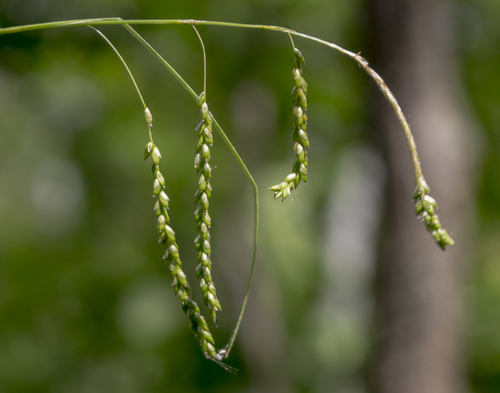
graceful sedge
Carex gracillima
An elegant, fountain-like woodland resident known for its nodding seed heads and regal purple base. The graceful sedge brings a touch of sophisticated texture to the shaded corners of your backyard.
Quick Identification
Size
Grows in clumps 30-90 cm (12-36 inches) tall with a similar spread; leaves are 3-8 mm (0.1-0.3 inches) wide.
Colors
Bright lime-green to deep forest-green foliage; distinctive reddish-purple or burgundy coloring on the leaf sheaths at the base of the plant.
Key Features
- Slender, drooping flower spikes that nod in the wind
- Deep reddish-purple tinting at the very base of the stems
- Loose, fountain-like clumping habit
- Smooth, beakless, oval-shaped seed casings (perigynia)
When You’ll See Them
Behavior
The graceful sedge is a quiet, elegant perennial that defines the aesthetic of a healthy eastern woodland. Unlike many aggressive turf grasses, this sedge grows in polite, non-invasive clumps that arch outward like a green fountain. It spends the early spring pushing up new, vibrant growth, followed quickly by the emergence of its namesake 'graceful' flowering spikes that dangle delicately from slender stems.
In the backyard ecosystem, this plant acts as a foundational species. It provides essential cover for ground-dwelling insects and small amphibians like wood frogs, who appreciate the cool, moist microclimate created beneath its arching leaves. While it doesn't move about like the animals on your camera, it reacts beautifully to the environment, swaying rhythmically with the breeze and changing from a bright spring green to a more muted tan as it goes dormant in the winter.
EverydayEarth exclusive
Camera Tips
Capturing the graceful sedge on a trail camera requires a different strategy than scouting for mobile wildlife. Since plants don't trigger traditional PIR (heat-motion) sensors, you should switch your AI-powered camera to 'Time-Lapse' mode. Setting the camera to take a photo every 15 to 30 minutes during daylight hours will allow you to create a stunning growth montage as the flower spikes emerge and begin to droop in late spring.
To highlight the 'purple-sheathed' characteristic that gives this species its alternative name, place your camera at a very low 'worm's eye' angle, no more than 5 inches off the ground. Aim the lens toward the base of the clump where the stems meet the soil. This perspective not only captures the unique burgundy color of the sheaths but also creates a dramatic forest-floor view that makes the tall flower spikes look like a towering canopy for any insects or small rodents passing through.
Position your camera so the sun is behind the plant during the 'Golden Hour' (shortly after sunrise or before sunset). The delicate, translucent seeds and thin stems of the graceful sedge catch the light beautifully, creating a glowing 'halo' effect that makes for professional-grade nature photography. If your camera allows for sensitivity adjustments, keeping it on a high-motion setting on a breezy day can also help you capture video clips of the plant's characteristic nodding motion, which is incredibly soothing to watch.
Similar Species
Species that look similar or are commonly confused with graceful sedge.
Frequently Asked Questions
Record graceful sedge at your habitat
Connect a camera to start building your own species record — AI identifies every visitor automatically.