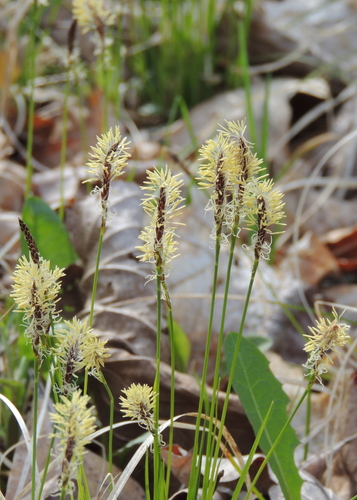
Pennsylvania sedge
Carex pensylvanica
A soft, flowing emerald carpet for the shade, Pennsylvania sedge is the unsung hero of the woodland garden, providing essential cover for backyard critters.
Quick Identification
Size
Height: 6-12 inches (15-30 cm); Spread: 8-12 inches (20-30 cm) via creeping rhizomes
Colors
Bright green to lime-green foliage; inconspicuous reddish-brown flower spikes; turns a warm tan in late winter
Key Features
- Low-growing, tufted grass-like foliage that arches gracefully
- Fine, narrow leaves approximately 1/8 inch wide
- Forms soft, dense mats through underground runners (rhizomes)
When You’ll See Them
Behavior
Pennsylvania sedge is a cool-season perennial that brings life to the woodland floor long before most other plants wake up. Unlike traditional turf grasses, this sedge grows in soft, fountain-like clumps that slowly merge into a lush, emerald carpet. It is famous for its 'tussock' growth habit, creating a textured surface that feels like a natural woodland rug.
In the backyard ecosystem, it acts as a foundational species. While it doesn't move like an animal, it 'behaves' as a critical host and shelter. It provides nesting material for birds and serves as a low-profile hideout for small mammals and beneficial insects. Because it is highly shade-tolerant, it often thrives in the difficult 'dry shade' areas under oak trees where little else will grow.
EverydayEarth exclusive
Camera Tips
When using an AI-powered camera with Pennsylvania sedge, think of the plant as a stage rather than the main actor. Because this sedge grows in dense, low mats, it is a highway for ground-dwelling wildlife. Position your camera at a low 'worm’s-eye' angle—no more than 5 to 10 inches off the ground. This perspective allows you to capture the small mammals like voles and shrews, or ground-feeding birds like towhees and sparrows, that weave through the blades. Use a wide-angle lens setting if available to capture the sweeping 'carpet' effect of the sedge bed.
For those interested in the plant's own lifecycle, Pennsylvania sedge is an excellent candidate for long-term time-lapse photography. Set your camera to take one photo every 6 hours starting in late March. By May, you will have a stunning visual record of the 'green-up' process, showing the sedge's reddish-brown flower spikes emerging before the leaves fully elongate. Ensure the camera is mounted to a sturdy stake, as the ground can shift during the spring thaw, which might ruin the alignment of your time-lapse.
If you are looking to capture animal interactions, place your camera near the edge of a sedge patch where it meets a wooded area or a garden path. This 'edge habitat' is where movement is most frequent. Since the sedge is often found under oak trees, expect high activity from squirrels and chipmunks burying or retrieving acorns. To avoid false triggers from the wind blowing the fine blades of the sedge, adjust your camera's sensitivity to 'medium' and ensure there aren't any rogue, extra-long blades directly in front of the PIR sensor.
Finally, the best lighting for photographing Pennsylvania sedge is 'dappled sunlight.' Direct midday sun can wash out the delicate green hues and create harsh shadows in the tufts. Aim for morning or late afternoon light when the sun is at an angle, highlighting the fine texture of the leaves. If your camera has a macro mode or a close-focusing distance, try to position it near the base of the plant in early spring to catch the tiny, fascinating flowers that many people overlook.
Similar Species
Species that look similar or are commonly confused with Pennsylvania sedge.
Frequently Asked Questions
Record Pennsylvania sedge at your habitat
Connect a camera to start building your own species record — AI identifies every visitor automatically.