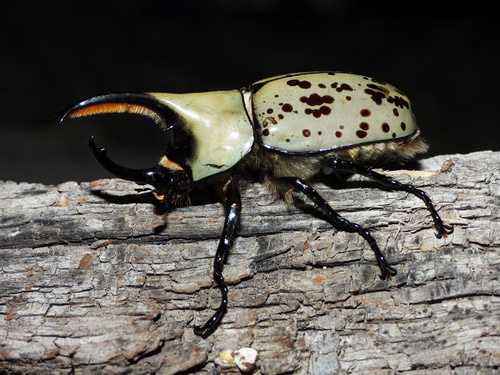
Grant's Hercules Beetle
Dynastes grantii
The undisputed heavyweight of the American Southwest, Grant's Hercules Beetle is a prehistoric-looking marvel that emerges with the desert monsoons. With its ghostly gray shell and magnificent horns, it is a bucket-list find for any backyard explorer.
Quick Identification
Size
Adults range from 40-85 mm (1.5-3.3 inches) in length; weight varies but they are among the heaviest insects in North America.
Colors
Pearly gray, greenish-white, or ashy elytra (wing covers) with irregular black or dark brown spots; males have long black horns, while females are hornless and often darker.
Key Features
- Large, forward-pointing cephalic and thoracic horns on males
- Ghostly gray or greenish-white shell with black speckles
- Color-changing elytra that darken with high humidity
- Strong, hooked tarsi (feet) for gripping bark
When You’ll See Them
Behavior
Grant's Hercules Beetles are the gentle giants of the desert southwest. Despite their formidable appearance and massive horns, these beetles are entirely harmless to humans and do not bite or sting. They spend the majority of their adult lives in the canopy of trees or scouting the forest floor for mates. They are remarkably strong, capable of lifting many times their own body weight, a trait they use during 'wrestling' matches where males attempt to flip rivals off tree branches to win the favor of a female.
These beetles are famous for their sensitivity to moisture. Their elytra are porous, and when the humidity rises—common during the Southwestern monsoon season—the shell absorbs moisture and turns from a light gray to a deep, dark brown or black. This unique physiological trait helps them blend into the damp bark of trees during rainstorms. While they are clumsy fliers, they are often drawn to artificial light sources in suburban areas, where they can be found resting on walls or sidewalks the following morning.
EverydayEarth exclusive
Camera Tips
To capture these armored titans on camera, your best bet is to leverage their love for sweets and their attraction to light. Set up your camera near a 'bait station' using a mixture of overripe mashed bananas, brown sugar, and a splash of maple syrup. Smear this concoction on the trunk of an ash or oak tree about four feet off the ground. Position your camera about 2-3 feet away from the bait. Because these beetles are relatively slow-moving when feeding, you don't need a high shutter speed, but a camera with a good macro focus or a close-up lens will capture the incredible detail of their spotted shells.
Lighting is the most critical factor. Grant's Hercules Beetles are highly phototactic, meaning they are drawn to light. If you have a porch light or a bright security light, try placing your camera nearby. For the best results, use a UV (blacklight) or a mercury vapor lamp near your camera setup; these specific wavelengths are irresistible to the beetles and will draw them in from the surrounding woods. Set your camera to trigger on 'high sensitivity' as their movement can be subtle until they reach the bait.
Timing is everything with this species. In Arizona and New Mexico, they emerge almost exclusively during the summer monsoon rains. Monitor the weather and ensure your camera is active on humid nights following a heavy rainstorm. This is also when you might catch the fascinating color-change phenomenon on video, as the beetles transition from dark to light as the humidity fluctuates. Because they are heavy, you might even hear them hit a wall or the ground before you see them—listen for a distinct 'thud' if you are monitoring your gear live.
Similar Species
Species that look similar or are commonly confused with Grant's Hercules Beetle.
Frequently Asked Questions
Record Grant's Hercules Beetle at your habitat
Connect a camera to start building your own species record — AI identifies every visitor automatically.