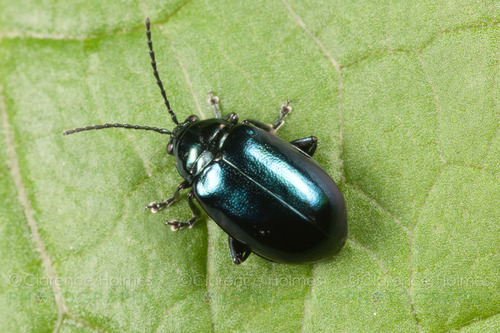
Grape Flea Beetle
Altica chalybea
A tiny metallic gem of the springtime garden, the Grape Flea Beetle is famous for its brilliant blue sheen and its impressive, flea-like jumping ability.
Quick Identification
Size
4-5 mm (0.16-0.20 inches) in length
Colors
Metallic dark blue, greenish-blue, or deep purple with a glossy, polished sheen
Key Features
- Metallic blue or purple oval-shaped body
- Enlarged hind thighs adapted for jumping
- Short, thread-like antennae
- Pronounced 'shoulder' area on the wing covers (elytra)
When You’ll See Them
Geographic range
Where Does the Grape Flea Beetle Live?
The Grape Flea Beetle is native to North America, where it is widely distributed across the eastern and central regions. Its territory stretches from the Atlantic coast westward to the Great Plains, and from southern Canada down to the Gulf of Mexico. This species is particularly abundant in the Great Lakes region and the Ohio River Valley, where wild grapes and commercial vineyards provide an ideal landscape for their population to thrive.
Basemap © OpenStreetMap contributors
Behavior
The Grape Flea Beetle is a spring specialist, emerging from its winter dormancy just as grapevines begin to show their first signs of life. These beetles are highly responsive to temperature, becoming active on the first warm days of spring. Their most distinctive behavior is their namesake 'flea-like' jump; when they feel the vibrations of an approaching predator or a curious gardener, they use powerful hind legs to launch themselves into the air and disappear into the leaf litter.
While the adults are known for their jumping and bud-boring, the larvae are more sedentary. After the adults mate in late spring, they lay orange-colored eggs on the underside of leaves. The resulting larvae are slow-moving and feed in groups, skeletonizing the foliage. Throughout their lifecycle, these beetles remain closely tied to their host plants, rarely venturing far from the vines that provide both their food and their breeding grounds.
EverydayEarth exclusive
Camera Tips
To capture high-quality images of the Grape Flea Beetle, you must utilize macro photography techniques. Because these beetles are only about 5 millimeters long, a standard trail camera will likely produce blurry results unless it has a dedicated macro mode or a close-up lens attachment. Mount your camera or smartphone on a steady tripod and focus on the swelling buds of grapevines or Virginia creeper in early spring. This 'bud-break' period is the only time adults congregate in predictable locations.
Lighting is critical for bringing out the beetle's metallic luster. Position your camera so that the sun is behind you or to the side, hitting the beetle's back at an angle. This will create a 'specular highlight' that emphasizes their brilliant blue or purple sheen. If you are using an AI-powered backyard camera, place it within 6-12 inches of a vine cluster. Since these insects are sensitive to motion, use a remote shutter or a motion-trigger setting to avoid scaring them away with your presence.
Don't forget the larvae later in the season. From late May through July, check the undersides of grape leaves. While they lack the metallic glint of the adults, the larvae are much slower and easier to photograph. Setting your camera to a high frame rate or burst mode is helpful when trying to catch an adult in action, as their jump is one of the fastest movements in the insect world, often occurring in just a fraction of a second.
Similar Species
Species that look similar or are commonly confused with Grape Flea Beetle.
Frequently Asked Questions
Record Grape Flea Beetle at your habitat
Connect a camera to start building your own species record — AI identifies every visitor automatically.