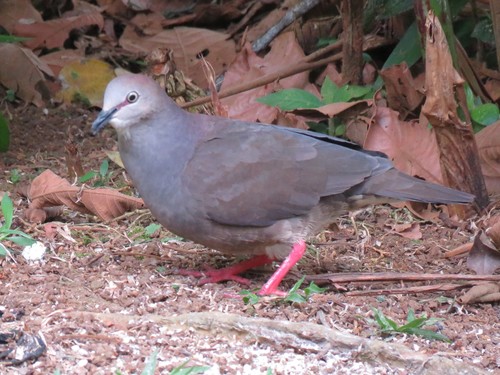
Gray-chested Dove
Leptotila cassinii
A secretive resident of the tropical understory, the Gray-chested Dove is a master of camouflage on the forest floor. With its soft grey breast and striking red legs, this elusive bird is a rewarding discovery for any backyard camera enthusiast.
Quick Identification
Size
22.5–26 cm (8.8–10.2 in) in length; weighs approximately 130–180 g (4.6–6.3 oz)
Colors
Soft grey chest and throat, olive-brown back and wings, pinkish-grey crown, and bright reddish-pink legs; sexes look similar.
Key Features
- Distinctive grey-white chest and throat
- Bright reddish-pink legs and feet
- Olive-brown upperparts with a slight iridescent sheen
- Pale grey forehead transitioning to a pinkish-grey crown
When You’ll See Them
Geographic range
Where Does the Gray-chested Dove Live?
The Gray-chested Dove is a resident of the humid tropical lowlands of Central and South America. Its range begins in southeastern Mexico and extends through the Caribbean and Pacific slopes of Belize, Guatemala, Honduras, Nicaragua, Costa Rica, and Panama, reaching its southernmost limit in northern Colombia. This bird is a true specialist of Middle American rainforests and is rarely found far from the dense cover of the humid tropics.
Basemap © OpenStreetMap contributors
Behavior
The Gray-chested Dove is a notoriously shy and terrestrial species, spending the majority of its life walking quietly across the forest floor. Unlike many other pigeons and doves that congregate in large flocks, this species is typically solitary or found in pairs. It moves with a rhythmic head-bobbing motion as it searches for food among the leaf litter, often staying close to dense undergrowth for a quick retreat.
When startled, the Gray-chested Dove performs a distinctive 'flush,' characterized by a loud, sudden flapping of wings as it flies a short distance into low-hanging branches. While they are not known for being particularly vocal in the presence of humans, their low, mournful 'whooo-oo' call is a hallmark sound of the tropical humid forest understory during the early morning hours.
EverydayEarth exclusive
Camera Tips
To capture high-quality footage of the Gray-chested Dove, ground placement is your most critical factor. Because these birds rarely venture into the canopy, your camera should be mounted very low—ideally between 10 and 15 inches off the ground. Angle the lens slightly upward or keep it perfectly level with the forest floor to capture the bird's eye-level perspective and the subtle details of its grey plumage.
Focus your camera efforts on 'micro-habitats' such as the edges of shaded footpaths or near the base of large, buttressed trees where leaf litter accumulates. These birds love damp, shaded areas; placing a camera near a small ground-level water feature or a shaded birdbath can significantly increase your chances of a sighting, as they frequently visit water sources to drink during the hottest parts of the day.
Since they are easily spooked by sudden movements, use a camera with a silent shutter and a fast trigger speed. Set your device to 'Burst Mode' to capture a series of photos, which helps in identifying the bird correctly if it is moving through the shadows. Avoid placing cameras in direct, harsh sunlight; the soft, filtered light of the understory better showcases the delicate grey and olive tones of their feathers.
Similar Species
Species that look similar or are commonly confused with Gray-chested Dove.
Frequently Asked Questions
Record Gray-chested Dove at your habitat
Connect a camera to start building your own species record — AI identifies every visitor automatically.