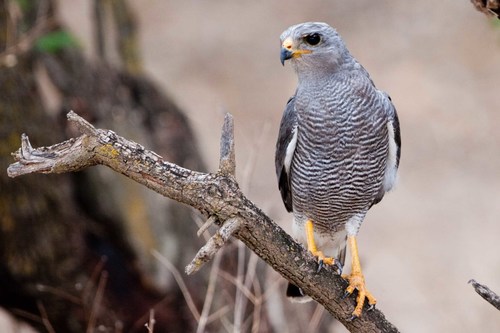
Gray Hawk
Buteo plagiatus
A sleek, whistling hunter of the desert riverbanks, the Gray Hawk is one of the most elegant raptors in the Americas. With its distinctive barring and agile flight, this 'Mexican Goshawk' is a prize find for any backyard wildlife enthusiast.
Quick Identification
Size
Length: 46–61 cm (18–24 in); Wingspan: 82–102 cm (32–40 in); Weight: 400–620 g (0.88–1.37 lbs)
Colors
Adults are pale slate-gray above with fine gray-and-white horizontal barring on the underparts. The tail is black with two to three conspicuous white bands. Juveniles are dark brown above with a cream-colored, heavily streaked chest.
Key Features
- Fine gray and white horizontal barring on breast
- Bold black and white tail bands
- Bright yellow cere and legs
- Short, rounded wings with a relatively long tail
When You’ll See Them
Geographic range
Where Does the Gray Hawk Live?
Native to the Americas, the Gray Hawk finds its northernmost limit in the southwestern United States, primarily within the lush river corridors of southern Arizona and the Rio Grande Valley of Texas. Its core range extends south throughout the coastal lowlands of Mexico and through Central America, reaching as far as northwestern Costa Rica. While the southern populations remain year-round residents, those breeding in the United States are migratory, heading south into Mexico for the winter months.
Basemap © OpenStreetMap contributors
Behavior
The Gray Hawk is often described as having the spirit of a forest-dwelling accipiter in the body of a soaring buteo. Unlike many of its cousins that prefer open fields, this raptor is a nimble navigator of dense river-bottom foliage. They are remarkably agile flyers, capable of chasing lizards through tangled branches with surprising speed. They are most famous for their vocal nature; during the breeding season, they frequently emit a loud, melancholy, whistling 'kleee-er' that can be heard long before the bird is seen.
While they do occasionally soar to high altitudes to defend their territory, they spend most of their time perched quietly on mid-level branches. From these vantage points, they scan the ground and tree trunks for movement. They are highly territorial and will fiercely dive-bomb intruders near their nest sites. Despite being somewhat shy, they have adapted well to suburban edges in the American Southwest where mature trees provide adequate nesting cover and lizard populations are high.
EverydayEarth exclusive
Camera Tips
To successfully capture a Gray Hawk on your trail camera, you need to focus on 'water and wood.' These hawks are highly dependent on riparian corridors and are frequent bathers. Placing a camera near a permanent water source, such as a shallow stream edge, a cattle tank, or a large backyard birdbath, is your most effective strategy. Because they often drop to the ground to drink or bathe during the heat of the afternoon, aim your camera at a downward angle roughly 2 to 3 feet off the ground toward the water's edge.
Gray Hawks are 'perch hunters' that frequently return to the same horizontal limbs to scan for prey. Look for 'plucking posts'—branches or stumps with nearby feathers or lizard remains. If you identify a favored perch, mount your camera 5-6 feet up an adjacent tree facing that limb. Use a high-speed trigger or video mode, as these hawks are incredibly fast when they launch into a strike; a standard photo mode might only capture a blur of gray wings.
In a backyard setting, you can attract them indirectly by creating a lizard-friendly environment. Large rock piles, fallen logs, and native desert plantings will draw in the whiptails and spiny lizards that Gray Hawks crave. If your AI-powered camera allows for specific scheduling, prioritize the mid-morning and late afternoon hours. During the nesting season (April through June), keep an eye out for adults carrying nesting material or prey, but be careful not to place cameras too close to active nests to avoid causing stress to the pair.
Similar Species
Species that look similar or are commonly confused with Gray Hawk.
Frequently Asked Questions
Record Gray Hawk at your habitat
Connect a camera to start building your own species record — AI identifies every visitor automatically.