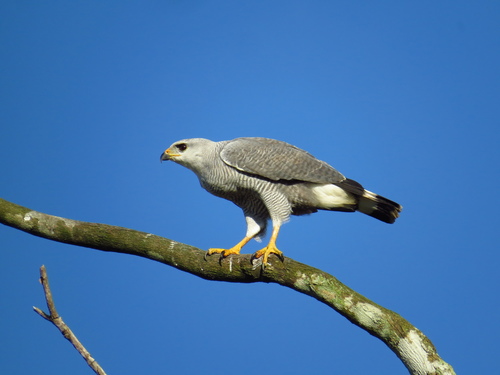
Gray-lined Hawk
Buteo nitidus
With its elegant silver-gray plumage and striking banded tail, the Gray-lined Hawk is a master of the forest edge. This neotropical raptor is a lizard-hunting specialist that brings a touch of wild majesty to suburban fringes and open woodlands alike.
Quick Identification
Size
Length: 38-46 cm (15-18 in); Wingspan: 75-90 cm (30-35 in); Weight: 350-500 g (0.8-1.1 lbs)
Colors
Adults have pale gray upperparts and finely barred gray-and-white underparts. The tail is black with 2-3 prominent white bands and a white tip. Juveniles are dark brown above with cream-colored, streaked underparts.
Key Features
- Finely barred 'salt and pepper' underparts
- Broad, rounded wings and relatively short tail
- Bold black-and-white banded tail pattern
- Yellow cere (nose) and legs contrasting with gray plumage
When You’ll See Them
Geographic range
Where Does the Gray-lined Hawk Live?
Native to the lush landscapes of Central and South America, the Gray-lined Hawk thrives across a vast territory stretching from the tropical corridors of El Salvador and Costa Rica down through the Amazon basin to northern Argentina. This raptor is a quintessential sight in the lowlands of Brazil, Colombia, and Venezuela, and it has even established a stronghold on the island of Trinidad. Unlike its northern cousin, this species is almost exclusively a resident of the neotropics, favoring the sun-drenched edges of humid forests and open savannas.
Basemap © OpenStreetMap contributors
Behavior
The Gray-lined Hawk is a patient perch-hunter, often seen sitting motionlessly on high, exposed branches or telephone poles at the edge of clearings. From these vantage points, it scans the ground for movement, executing a swift, gliding dive once prey is spotted. Unlike some more aggressive raptors, they tend to stay within the mid-to-high canopy of forest edges, making them a common sight for those who know where to look along woodland margins.
These hawks are primarily solitary or found in pairs during the breeding season. They are highly territorial and will defend their nesting sites with shrill, whistling calls that sound like a series of descending 'kleee-ooo' notes. While they are generally wary of humans, they have adapted well to fragmented landscapes and are often found in rural agricultural areas or suburban parks that provide enough tall trees for nesting and open ground for hunting.
EverydayEarth exclusive
Camera Tips
To capture a Gray-lined Hawk on a trail camera, focus on 'hunting perches' rather than the ground. Look for dead snags or horizontal branches that overlook a clearing, meadow, or garden edge. Mounting your camera 10 to 15 feet high on an adjacent tree, angled slightly downward toward a prominent branch, is the most effective way to catch them resting between hunts.
Because these hawks are lizard specialists, placing a camera near a stone wall, a woodpile, or a sunny garden patch where reptiles frequent can trigger 'action shots' during a strike. Set your camera to a fast trigger speed and high-shutter-speed burst mode; their dives are incredibly quick, and a standard single-shot setting may only capture a blur of gray feathers.
Water is a significant draw in drier climates or during the dry season. A raised birdbath or a consistent dripping water feature in a quiet corner of a yard can entice them down for a drink or a bath. Position the camera about 5-8 feet away from the water source, ensuring the lens is shaded to prevent glare from the tropical sun, which can wash out the fine gray barring that identifies the species.
Similar Species
Species that look similar or are commonly confused with Gray-lined Hawk.
Gray Hawk
Very similar but found further north (Mexico/US); has slightly coarser barring and different vocalizations.
Roadside Hawk
Smaller with a brownish-gray wash and distinctive rufous (reddish) patches on the wings visible in flight.
Broad-winged Hawk
Migratory species with a thicker white band on the tail and lack of fine gray barring on the underparts.
Frequently Asked Questions
Record Gray-lined Hawk at your habitat
Connect a camera to start building your own species record — AI identifies every visitor automatically.