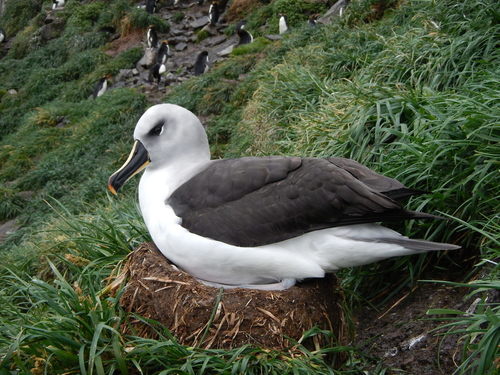
Gray-headed Albatross
Thalassarche chrysostoma
A majestic voyager of the Southern Ocean, the Gray-headed Albatross is famous for its striking slate plumage and its ability to circle the entire globe in just six weeks.
Quick Identification
Size
Length of 81 cm (32 in) with a wingspan of 2.2 m (7.2 ft); weight ranges from 2.8 to 4.4 kg (6.2–9.7 lbs).
Colors
Ashy-gray head, throat, and neck; dark gray mantle and tail; white underparts. Bill is black with bright yellow ridges on the top and bottom and a pinkish tip.
Key Features
- Distinctive slate-gray head and neck
- Black bill with bright yellow stripes on the culmen and lower mandible
- Large 7-foot wingspan with dark upperwings
- White underwings with narrow black margins
When You’ll See Them
Geographic range
Where Does the Gray-headed Albatross Live?
The Gray-headed Albatross is a true circumpolar wanderer of the Southern Hemisphere, circling the globe in the cold, nutrient-rich waters of the Southern Ocean. They are most commonly found nesting on isolated island outposts such as South Georgia, the Kerguelen Islands, and Macquarie Island. During the non-breeding season, they migrate north into more temperate waters, frequently reaching the coasts of South America, South Africa, Australia, and New Zealand.
Basemap © OpenStreetMap contributors
Behavior
The Gray-headed Albatross is a master of the Southern Ocean winds, spending the vast majority of its life at sea. It utilizes a flight technique called 'dynamic soaring,' which allows it to travel thousands of miles with minimal wing flapping by leveraging wind gradients above the waves. Unlike many other birds, they are biennial breeders, typically nesting only every second year because the process of raising a single chick is so energy-intensive.
These birds are largely solitary when foraging but become highly social on their remote nesting islands, where they build large pedestal nests out of mud and grass. They are known for their incredible endurance; a single bird can circumnavigate the Southern Ocean in just 46 days. While they generally avoid human contact, they are frequently seen following fishing vessels to scavenge for discarded offal, a behavior that unfortunately puts them at risk of accidental capture.
EverydayEarth exclusive
Camera Tips
Capturing a Gray-headed Albatross on camera is a challenge reserved for those in coastal southern regions or on research expeditions. For those on sub-antarctic islands, place cameras on high, wind-swept ridges or tussock-covered slopes where the birds build their pedestal nests. Because of the intense Southern Ocean winds, use heavy-duty mounts or weighted tripods to prevent camera shake or the loss of equipment.
Set your camera to a fast shutter speed (at least 1/1000s) to freeze the motion of these high-speed flyers. If you are monitoring a nest site, use a time-lapse setting with 15-minute intervals to capture behavior without filling the SD card too quickly, as these birds spend long periods brooding. Ensure your camera housing is rated for extreme cold and high-salinity environments, as salt spray can quickly corrode standard electronics.
Since these birds are sensitive to disturbance, avoid using bright white flashes at night; instead, opt for high-quality No-Glow infrared sensors. Place the camera at a distance of at least 5 to 10 meters from the nest to avoid stressing the parents. If you are on a vessel, mounting a camera to the stern rail with a gimbal can help stabilize shots of the birds following the wake.
Similar Species
Species that look similar or are commonly confused with Gray-headed Albatross.
Frequently Asked Questions
Record Gray-headed Albatross at your habitat
Connect a camera to start building your own species record — AI identifies every visitor automatically.