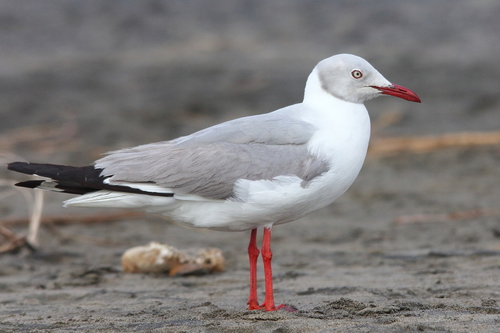
Gray-hooded Gull
Chroicocephalus cirrocephalus
A social and elegant traveler of the Southern Hemisphere, the Gray-hooded Gull is as comfortable on a freshwater lake as it is on a salty coast. Known for its soft grey hood and crimson accents, it is a frequent visitor to docks and backyards near the water.
Quick Identification
Size
38–45 cm (15–18 in) long with a 100–115 cm (39–45 in) wingspan; weighs 250–400 g (9–14 oz)
Colors
Pale grey hood in breeding adults, white body, medium-grey wings with black tips, and dark red legs and bill. In non-breeding season, the hood fades to a faint grey smudge behind the eye.
Key Features
- Pale grey hood covering the head and upper throat
- Crimson-red bill and legs
- White flashes on wingtips visible in flight
- Pale yellow-white iris with a thin red eye-ring
When You’ll See Them
Geographic range
Where Does the Gray-hooded Gull Live?
The Gray-hooded Gull is native to two distinct regions: Sub-Saharan Africa and South America. In Africa, they are found from the coastlines of Senegal and Ethiopia down to South Africa, with significant populations around the inland lakes of the Rift Valley. In South America, their range extends from the coasts of Ecuador and Brazil south through the river systems of Uruguay and Argentina. While not strictly migratory, these gulls are highly nomadic and dispersive, often wandering far from their breeding grounds during the winter months.
Basemap © OpenStreetMap contributors
Behavior
Gray-hooded Gulls are highly social and gregarious birds, often found in large, chatter-filled colonies. They are notably more comfortable moving between freshwater and saltwater than many other gull species, frequently transitioning from coastal estuaries to inland Great Rift Valley lakes or South American rivers. Their flight is light and buoyant, and they are adept at snatching insects from the air or hovering over water to pick up small fish.
Interaction with humans is common, especially in harbor towns and fishing villages where they have learned to scavenge for offal and scraps. Despite their social nature with their own kind, they can be territorial around nesting sites, using a variety of harsh, raspy calls to deter intruders. During the day, they spend a significant amount of time preening and bathing in shallow water to maintain their plumage.
EverydayEarth exclusive
Camera Tips
To capture the best footage of Gray-hooded Gulls, location is everything. Place your AI-powered camera near the edge of a water source, such as a shallow lagoon or a large birdbath if you live in a coastal area. Set the camera at a very low height—roughly 6 to 12 inches off the ground—using a stake or a low-profile tripod. This 'bird's eye' perspective creates an intimate connection in the footage, highlighting their striking red bills and pale eyes better than a high-angle shot.
Since gulls are attracted to movement and reflections, a solar-powered water dripper or a small fountain in a shallow basin can serve as a natural lure. Avoid placing the camera facing directly into the sun; instead, position it so the morning or evening light illuminates the bird from the side or front. This prevents the pale grey and white plumage from becoming a 'blown out' white blur in the video.
Given their quick movements, set your camera to its highest possible frame rate (FPS) to capture the detail of their wing stretches and social displays. If your camera has a 'pre-roll' feature, enable it, as gulls often land suddenly and depart just as quickly. In suburban settings, rooftop placements near chimneys or ledges can also be surprisingly effective, as these birds often use high vantage points to scout for food.
Similar Species
Species that look similar or are commonly confused with Gray-hooded Gull.
Hartlaub's Gull
Smaller with a much fainter hood and dark eyes; primarily restricted to the southwestern coast of Africa.
Brown-headed Gull
Has a darker brown hood and distinct white 'mirrors' on its black wingtips; found primarily in Central and South Asia.
Black-headed Gull
Features a darker, coffee-colored hood and a dark iris; it is the most common hooded gull in Europe and Asia.
Frequently Asked Questions
Record Gray-hooded Gull at your habitat
Connect a camera to start building your own species record — AI identifies every visitor automatically.