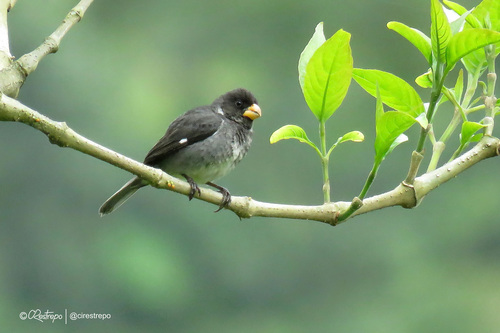
Gray Seedeater
Sporophila intermedia
A charming songbird of the South American lowlands, the Gray Seedeater is easily recognized by the male's striking leaden plumage and bright yellow bill. Thriving in grasslands and gardens alike, this tiny finch-like bird is a favorite for its sweet melodies and social nature.
Quick Identification
Size
Length of 10.5–11.5 cm (4.1–4.5 in); weighs approximately 10–12 g (0.35–0.42 oz).
Colors
Males are lead-gray with a white belly and a bright yellow bill; females are olive-brown with a dark bill.
Key Features
- Male has uniform lead-gray upperparts
- Bright yellow or orange-yellow bill in adult males
- Tiny white wing speculum visible when perched
- Small, stubby, seed-crushing beak
When You’ll See Them
Geographic range
Where Does the Gray Seedeater Live?
The Gray Seedeater is native to the northern regions of South America. Its core range spans across Venezuela and Colombia, extending into northern Brazil, Guyana, and eastern Ecuador. It is also a very common resident on the islands of Trinidad and Tobago, where it thrives in both rural pastures and suburban outskirts.
Basemap © OpenStreetMap contributors
Behavior
The Gray Seedeater is a social and energetic bird, often found in small groups or mixed-species flocks alongside other seedeaters and grassquits. They are most famous for the male's melodic song, which is a series of sweet whistles and trills delivered from a prominent perch, such as a tall grass stalk or a low fence line. During the breeding season, males become more territorial, but they generally remain tolerant of human presence.
These birds are highly adapted to open landscapes and often frequent agricultural fields and gardens. They move with quick, hopping motions through tall grass, using their specialized bills to strip seeds directly from the stems. While they are primarily active in the early morning and late afternoon, they can be seen foraging throughout the day, especially during the rainy season when food is abundant.
EverydayEarth exclusive
Camera Tips
To capture the Gray Seedeater on camera, focus your efforts on ground-level or low-elevation setups. Position your camera approximately 0.5 to 1 meter (1.5 to 3 feet) off the ground, aiming toward patches of tall, seeding grasses or low-hanging shrubs. These birds rarely spend time in high canopies, preferring to forage within the safety of dense grass cover. If your backyard has a bird bath, this is an ideal focal point, as seedeaters are frequent drinkers and bathers, especially in the heat of the afternoon.
Because of their small size and rapid movements, use a camera with a high trigger speed. If your AI-powered camera allows for sensitivity adjustments, set it to the highest level to ensure the motion of a 10-gram bird triggers the recording. A fast shutter speed or a 60fps video setting is recommended to capture the detail of the male's yellow bill and gray plumage without motion blur as he flits between grass stems.
In terms of baiting, you don't necessarily need a traditional bird feeder. Instead, leaving a patch of your lawn to grow wild and produce natural grass seeds is the most effective way to attract them. However, a platform feeder with fine thistle or nyjer seed can also work. Ensure the camera is positioned to capture the early morning light, as the Gray Seedeater is most active and vocal just after sunrise.
Similar Species
Species that look similar or are commonly confused with Gray Seedeater.
Frequently Asked Questions
Record Gray Seedeater at your habitat
Connect a camera to start building your own species record — AI identifies every visitor automatically.