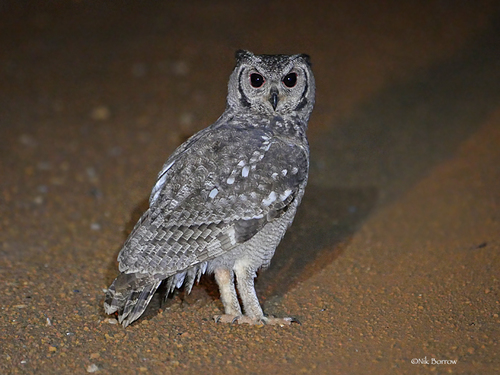
Grayish Eagle-Owl
Bubo cinerascens
A silent sentinel of the African savanna, the Grayish Eagle-Owl is a master of nighttime camouflage. Recognizable by its soulful dark eyes and intricate, wavy plumage, this resilient hunter brings a touch of wild mystery to the dry woodlands it calls home.
Quick Identification
Size
40–43 cm (16–17 in) in length; wingspan of approx. 100–120 cm (39–47 in); weighs 600–800 g (1.3–1.8 lbs)
Colors
Brownish-grey overall with fine white wavy lines (vermiculations); dark brown eyes; greyish-white facial disc with a thick dark border
Key Features
- Deep brownish-black eyes (unlike the yellow eyes of similar species)
- Fine, wavy 'vermiculated' patterns across the belly and chest
- Small but distinct ear tufts
- Pale, greyish-brown facial disc with a prominent dark rim
When You’ll See Them
Geographic range
Where Does the Grayish Eagle-Owl Live?
The Grayish Eagle-Owl is native to the northern regions of sub-Saharan Africa, inhabiting a broad, horizontal belt known as the Sahel. Its range extends from the Atlantic coast in Senegal and Mauritania eastward through Mali, Niger, and Nigeria, all the way to the Horn of Africa in Ethiopia, Somalia, and northern Kenya. This species is a resilient resident of these arid and semi-arid landscapes, rarely wandering far from its established territory.
Basemap © OpenStreetMap contributors
Behavior
The Grayish Eagle-Owl is a stealthy, nocturnal hunter that spends the daylight hours tucked away in dense foliage, rocky crevices, or occasionally in the abandoned stick nests of larger birds like crows or vultures. They are highly territorial and use a series of low-pitched, rhythmic hoots to define their boundaries at dusk. While they are solitary by nature, they are often seen in pairs during the breeding season, frequently returning to the same roosting sites for years.
When hunting, this species utilizes a 'sit-and-wait' strategy. They perch on low branches or rocky outcrops, using their incredible hearing and low-light vision to detect movement on the ground. Once prey is spotted, they glide down silently for a strike. Despite their somewhat imposing size, they are remarkably well-camouflaged; their plumage perfectly mimics the bark of acacia trees and the mottled shadows of the savanna, making them nearly invisible to the untrained eye during the day.
EverydayEarth exclusive
Camera Tips
To successfully capture a Grayish Eagle-Owl on your backyard or trail camera, identify their preferred 'sentinel' perches. These owls favor high-visibility spots such as fence posts, the tops of large rocks, or low-hanging horizontal branches near open ground. Mount your camera 1.5 to 2 meters (5-6 feet) high, aiming at the perch or the clearing directly beneath it. Because they are strictly nocturnal, a 'No-Glow' or 'Black' infrared flash is essential; standard red-glow LEDs can sometimes startle the owl or wash out the fine detail of their vermiculated feathers.
Attracting this species is best done by attracting their prey. Maintaining a small, wild patch of grass or a compost area can draw in the rodents and large beetles the owls hunt. If you have a birdbath, keep it clean and full, as these owls are known to visit water sources for a drink during the dry season. Position the camera with the water source in the mid-ground to capture both drinking and potential bathing behavior, which usually occurs shortly after dusk.
For the best results, use a high-speed trigger setting. These owls move with surprising speed when they drop from a perch. Setting your camera to 'Hybrid Mode'—taking a high-resolution photo followed by a 15-second video—allows you to record their movements and, if you're lucky, their deep, double-note hooting. In the Sahel regions, the dry season (October to May) is often the best time for sightings, as the vegetation is thinner and the owls are more vocal while defending breeding territories.
Similar Species
Species that look similar or are commonly confused with Grayish Eagle-Owl.
Frequently Asked Questions
Record Grayish Eagle-Owl at your habitat
Connect a camera to start building your own species record — AI identifies every visitor automatically.