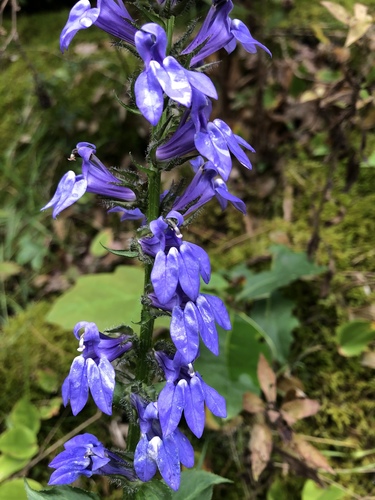
great blue lobelia
Lobelia siphilitica
A stunning late-summer standout, the Great Blue Lobelia transforms damp garden corners into a sea of electric blue. This native favorite is a master at attracting bumblebees and hummingbirds with its uniquely tubular blooms.
Quick Identification
Size
1-4 feet (30-120 cm) tall; 1-1.5 feet (30-45 cm) wide
Colors
Vibrant violet-blue to lavender flowers; bright green, lance-shaped leaves with finely serrated edges
Key Features
- Spike-like clusters of tubular flowers
- Two-lipped petals with three lower lobes and two upper lobes
- Alternative, serrated leaves along a sturdy central stem
- Blooms from late summer through early autumn
When You’ll See Them
Behavior
Great blue lobelia is a hardy, clump-forming perennial that acts as a cornerstone of the late-summer ecosystem. Unlike many garden flowers that fade by August, this species hits its stride just as other plants are beginning to wither. It is known for its relatively short lifespan of a few years, but it compensates by being a prolific self-seeder, often creating a naturalized drift of blue in moist areas of a backyard.
This plant has evolved a fascinating relationship with its primary pollinators, particularly large bumblebees. The structure of the flower requires a heavy insect to land on the lower lip, which triggers the reproductive organs to brush against the bee's back. While it is non-aggressive, it is also unpalatable to most mammalian herbivores like deer and rabbits, making it an excellent choice for gardens where wildlife browsing is a concern.
EverydayEarth exclusive
Camera Tips
To capture the true beauty of the great blue lobelia, place your camera on a low-profile tripod or stake at a height of approximately 24 to 30 inches. This puts the lens directly at eye-level with the central flower spike, where most of the action happens. Because these flowers are a magnet for bumblebees and the occasional hummingbird, using a 'High' sensitivity trigger setting or a fast-interval time-lapse is essential for catching these quick-moving visitors in action.
Lighting is the most critical factor for this species. The deep violet-blue pigments can easily become 'blown out' or appear purple in harsh midday sun. For the most accurate color representation, schedule your camera to be active during the 'golden hours' of shortly after sunrise or just before sunset. If your camera allows for manual exposure settings, slightly underexposing the image can help preserve the rich saturation of the blue petals.
If you are using an AI-powered camera like those from EverydayEarth, position it about 3 to 5 feet away from the plant. This distance is the 'sweet spot' that allows the AI to recognize both the plant structure and the incoming pollinators. To add a cinematic touch, try to angle the camera so that the morning sun provides a backlight; this will make the fine hairs on the stem and the nectar-rich tubes of the flowers glow, creating stunning high-definition captures.
For long-term monitoring, consider a seasonal time-lapse. Set the camera to take one photo every 6 hours starting in late July. This will allow you to document the 'bottom-up' blooming pattern, where the flowers at the base of the spike open first, followed by a slow climb of color toward the tip over several weeks. This is a fantastic way to visualize the plant's phenology and its response to local rainfall and temperature changes.
Similar Species
Species that look similar or are commonly confused with great blue lobelia.
Frequently Asked Questions
Record great blue lobelia at your habitat
Connect a camera to start building your own species record — AI identifies every visitor automatically.