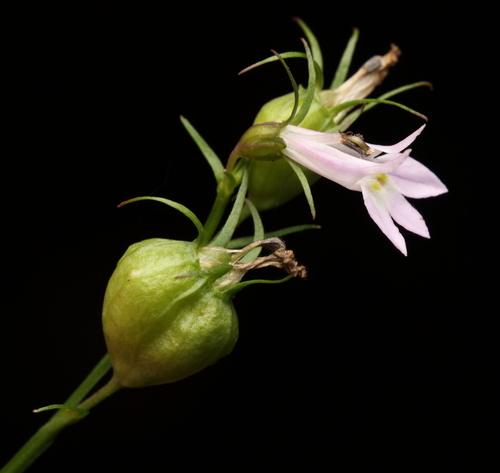
Indian tobacco
Lobelia inflata
Often overlooked until its seed pods swell into tiny green balloons, Indian tobacco is a fascinating native wildflower that brings a touch of delicate blue to the late summer landscape.
Quick Identification
Size
15–100 cm (6–40 inches) in height with flowers approximately 6–8 mm (0.25 inches) long
Colors
Pale blue to light lavender petals; light green stems covered in fine white hairs
Key Features
- Small, two-lipped tubular flowers
- Inflated, bladder-like seed pods at the base of flowers
- Highly hairy (pubescent) square-ish stems
- Alternate, ovate leaves with irregular teeth
When You’ll See Them
Behavior
Indian tobacco is an annual or biennial wildflower that follows a distinct summer-to-fall growth cycle. It is often found colonizing disturbed soils, garden edges, or open woodlands where sunlight can reach the forest floor. Unlike showier garden plants, this species focuses its energy on producing large quantities of seeds, which are housed in the namesake 'inflated' capsules that remain on the plant long after the delicate blue petals have fallen.
Historically, the plant has a complex relationship with humans. While its common name suggests use as a tobacco substitute, it contains the alkaloid lobeline, which is chemically similar to nicotine but highly potent. It was nicknamed 'puke weed' because of its ability to induce vomiting when ingested. In the wild, its primary 'behavior' is its interaction with small pollinators like sweat bees and small butterflies, which are the only insects light enough to navigate its tiny, intricate blossoms.
EverydayEarth exclusive
Camera Tips
Capturing Indian tobacco on a backyard or trail camera requires a different approach than filming mobile wildlife. Because the flowers are relatively small (less than a quarter-inch), you should position your camera on a tripod or mount just 12 to 18 inches from the ground. Ensure your camera is set to a macro or close-focus mode if available. If you are using an AI-powered camera designed for birds, you may need to disable 'motion only' triggers and use time-lapse mode instead, as the slight swaying of the stem in the wind might not always trigger a recording.
The most visually interesting stage of this plant is the development of the seed pods. I recommend setting up your camera in mid-August when the flowers are in full bloom and leaving it in place for several weeks. By using a time-lapse setting of one photo every hour during daylight, you can capture a stunning sequence of the delicate blue petals dropping away and the green calyx swelling into the characteristic 'inflated' bladder that gives the species its name.
Lighting is crucial for this species because the pale lavender flowers can easily look 'washed out' in direct, midday sun. For the best color saturation and to highlight the fine hairs on the stem, try to angle your camera so the plant is backlit during the 'golden hour' (shortly after sunrise or before sunset). If your camera allows for manual exposure adjustments, slightly underexposing the image will help bring out the subtle blue hues of the petals against the green background.
Finally, consider the pollinators. Indian tobacco is a favorite of small, metallic-colored sweat bees. If your camera has a high-speed trigger, aim it at a cluster of open flowers on a calm, sunny day. To increase your chances of capturing insect activity, ensure there is no competing movement in the background (like long grass) that might distract the AI or fill up your SD card with false triggers.
Similar Species
Species that look similar or are commonly confused with Indian tobacco.
Frequently Asked Questions
Record Indian tobacco at your habitat
Connect a camera to start building your own species record — AI identifies every visitor automatically.