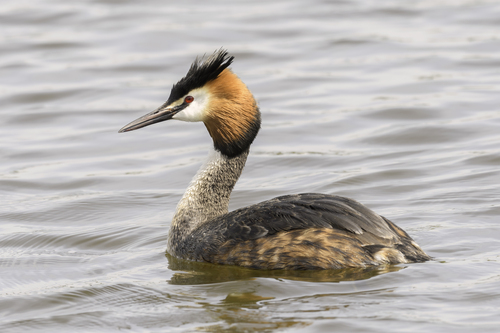
Great Crested Grebe
Podiceps cristatus
Witness the elegance of the Great Crested Grebe, a master of the water known for its stunning 'weed dance' and striking orange ruffs. From carrying chicks on their backs to their expert diving skills, these birds are a jewel of the temperate wetlands.
Quick Identification
Size
Length: 46–51 cm (18–20 in); Wingspan: 59–73 cm (23–29 in); Weight: 0.9–1.5 kg (2–3.3 lbs)
Colors
Breeding adults have a dark crown with two black tufts, chestnut and black cheek ruffs, a white face, and a long white neck. Body is dark brown on top and white underneath. Non-breeding adults lose the colorful ruffs and have a white face.
Key Features
- Distinctive double-pointed black crest tufts
- Vibrant orange-brown and black neck ruffs during breeding
- Long, elegant white neck and dagger-like pinkish bill
- Striking ruby-red eyes
- Streamlined body that sits low in the water
When You’ll See Them
Geographic range
Where Does the Great Crested Grebe Live?
The Great Crested Grebe is native to a vast area of the Old World, stretching across Europe and Asia into parts of Africa and Australasia. It is a common sight from the British Isles and Western Europe all the way through Central Asia to China and Japan, with southern populations established in Australia, New Zealand, and Sub-Saharan Africa. While northern populations are often migratory to avoid freezing waters, birds in temperate regions like the United Kingdom and Australia tend to be year-round residents.
Basemap © OpenStreetMap contributors
Behavior
The Great Crested Grebe is renowned for its incredibly complex and beautiful courtship ritual, known as the 'weed dance.' Pairs face each other, shaking their heads and rising out of the water chest-to-chest while offering bits of waterweed. This display is one of the most sophisticated in the avian world and is a highlight for any wildlife observer. Unlike many other water birds, grebes are highly adapted to life on the water and are actually quite clumsy on land because their legs are positioned so far back on their bodies.
These birds are exceptionally attentive parents. After the chicks hatch, they are often seen riding on the backs of their swimming parents, tucked safely into the feathers to stay warm and protected from underwater predators. While they are generally shy of humans, they have become increasingly accustomed to people in urban parks and suburban wetlands, provided they have enough reed cover for nesting. They are masterful divers, often disappearing beneath the surface for up to 30 seconds at a time to hunt fish.
EverydayEarth exclusive
Camera Tips
Capturing the Great Crested Grebe requires a camera placement that respects their aquatic lifestyle. Since these birds rarely come onto land, you should position your camera on a low-profile stake or a specialized floating mount near the edge of reed beds or along a quiet shoreline. Aim the lens about 6 to 12 inches above the water level; this low-angle perspective provides an intimate view of the bird and captures the beautiful reflections on the water surface.
Timing is critical for the best footage. Set your camera to be most active during the early morning hours when the water is often still and the light is soft. This is when they are most likely to engage in their famous courtship displays or when you might catch a parent 'ferrying' chicks on its back. Because grebes are fast-moving when they dive or display, use a high-speed trigger setting and a fast shutter speed if your camera allows, to avoid motion blur during their vigorous head-shaking rituals.
Avoid using traditional food baits, as grebes are specialized hunters. Instead, focus on 'environmental lures'—look for small gaps in the reeds where they naturally enter and exit their nesting sites. If you are placing a camera on a private pier or dock, ensure it is camouflaged with natural materials like dry reeds or driftwood. During the breeding season, be extremely careful not to disturb active nests, as grebes are sensitive to human presence and may abandon their eggs if they feel threatened.
Similar Species
Species that look similar or are commonly confused with Great Crested Grebe.
Frequently Asked Questions
Record Great Crested Grebe at your habitat
Connect a camera to start building your own species record — AI identifies every visitor automatically.