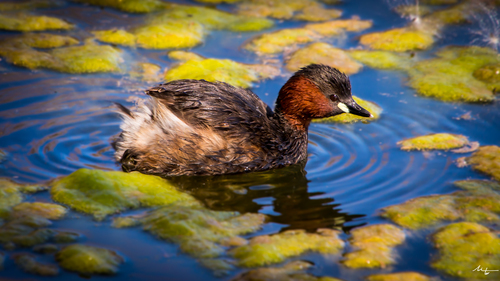
Little Grebe
Tachybaptus ruficollis
Meet the 'dabchick,' a tiny, fluff-butted master of the underwater world. With its vibrant red neck and disappearing act, this little diver is a favorite for backyard pond owners and wetland explorers alike.
Quick Identification
Size
Length: 23–29 cm (9–11.5 in); Wingspan: 40–45 cm (15.7–17.7 in); Weight: 120–235 g (4–8 oz)
Colors
Breeding adults have dark brown bodies with a distinctive chestnut-red neck and cheeks; non-breeding birds are a more uniform buff-brown with a pale throat. Both phases feature a notable pale yellow patch at the gape (base of the bill).
Key Features
- Stocky, rounded body with a 'fluffy' rear and no visible tail
- Bright yellow patch at the base of the beak (gape)
- Rich chestnut-red neck during breeding season
- Expert diver that sinks underwater almost instantly when startled
When You’ll See Them
Geographic range
Where Does the Little Grebe Live?
Native across a vast expanse of the Old World, the Little Grebe is a truly international resident. It is found throughout almost all of Europe, most of Africa south of the Sahara, and across southern and eastern Asia, reaching as far as Japan and Indonesia. While many populations are resident year-round, birds in the colder northern reaches of Europe and Asia are known to migrate to more temperate coastal or southern regions during the winter months to find ice-free water. This wide distribution makes them one of the most successful and widespread members of the grebe family, thriving in any freshwater environment that provides adequate cover.
Basemap © OpenStreetMap contributors
Behavior
The Little Grebe, affectionately known as the 'dabchick,' is a shy and secretive water bird. Unlike ducks, they are highly specialized for an aquatic life, with legs positioned far back on their bodies—making them exceptional swimmers but extremely clumsy on land. They are most famous for their vanishing act; when threatened, they can slowly sink beneath the surface without a ripple or dive suddenly to reappear far from the original spot.
Socially, they are often solitary or found in pairs during the breeding season, though they may form small, loose groups in winter. They are highly territorial when nesting, often engaging in 'trilling' duets to mark their space. While they generally avoid human contact, they can become accustomed to quiet observers in suburban park ponds and larger backyard water features that offer enough vegetative cover.
EverydayEarth exclusive
Camera Tips
Capturing the Little Grebe on camera requires patience and strategic placement, as they spend almost all their time on the water. To get the best results, mount your AI-powered camera just a few inches above the water level on a stable post, dock, or a specialized floating mount. A low-angle shot provides a more intimate, professional look at the bird and helps the AI better recognize the chestnut neck markings during breeding season. Aim the camera toward the edge of reed beds or floating vegetation where the birds frequently forage or bring their young.
Because grebes are sensitive to motion, use a camera with a high-speed trigger. If your camera is placed on a bank, ensure the PIR (Passive Infrared) sensor is angled to avoid picking up the constant movement of ripples or waves, which can lead to hundreds of false triggers. Setting a short 'detection delay' or using a 'burst mode' is essential, as these birds can dive and vanish in less than a second. Early morning light is your best friend here, as the low sun highlights the glossy plumage and the bright yellow gape patch.
While baiting isn't typically effective for these insectivores, you can 'lure' them by ensuring your pond or waterfront area has plenty of native submerged plants that attract the small fish and larvae they eat. Avoid disturbing the camera during the breeding season (late spring), as Little Grebes are notorious for abandoning nests if they feel too exposed. If your camera is equipped with sound recording, the high-pitched, whinnying 'trill' is a perfect acoustic signature to listen for, often serving as the first sign that a grebe has entered the frame.
Similar Species
Species that look similar or are commonly confused with Little Grebe.
Pied-billed Grebe
Found in the Americas; has a thicker, light-colored bill with a black band during breeding.
Great Crested Grebe
Much larger with a long white neck and ornate head plumes; lacks the Little Grebe's 'fluffy' rear appearance.
Eurasian Coot
Larger with a stark white beak and forehead shield; stays mostly on the surface rather than diving constantly.
Frequently Asked Questions
Record Little Grebe at your habitat
Connect a camera to start building your own species record — AI identifies every visitor automatically.